
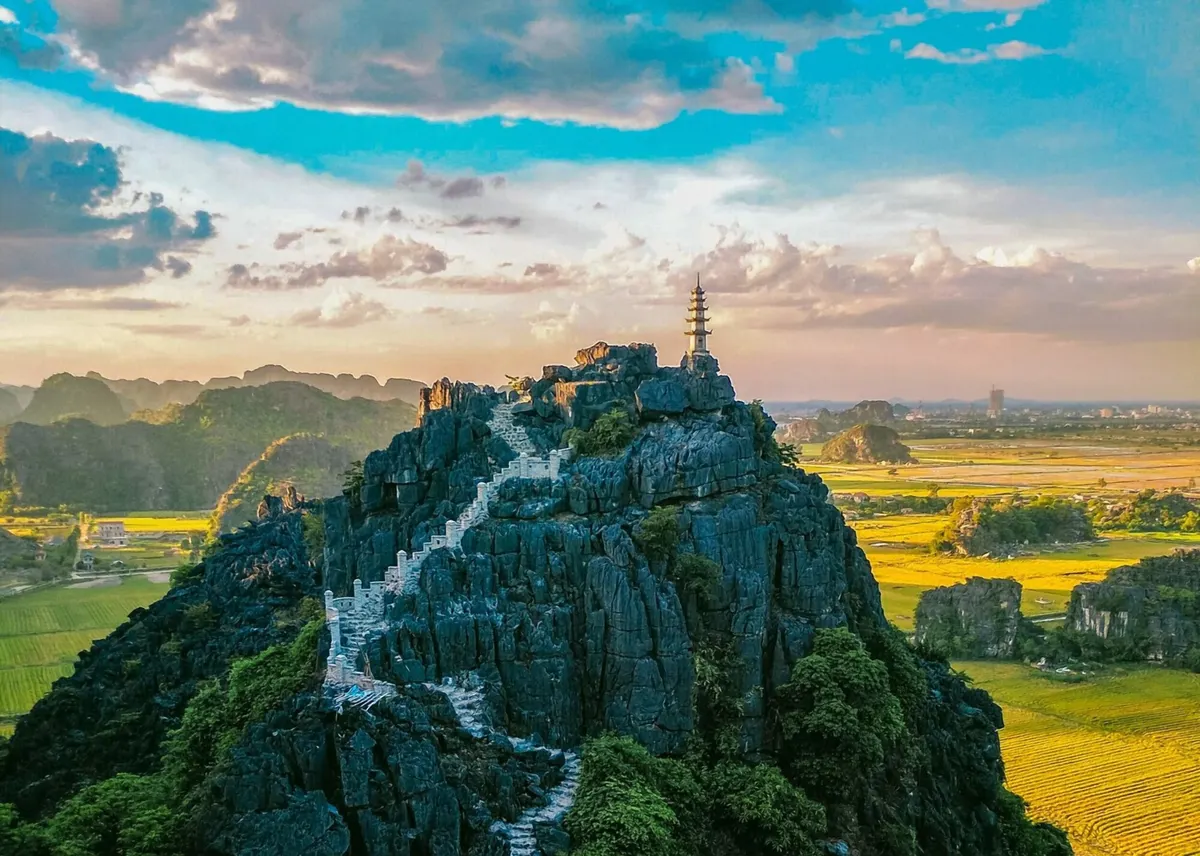
Bai Dinh Pagoda represents a monumental Buddhist complex situated within Vietnam's Ninh Binh Province, specifically in Gia Sinh Commune, to the west of the former Hoa Lu capital. Recognized for its profound spiritual and historical significance, the site spans an impressive 539 hectares, encompassing both an ancient pagoda and a more recently constructed, expansive complex. It serves as a major pilgrimage destination and a prominent cultural landmark, drawing visitors keen to explore its unique blend of traditional Vietnamese design and grand scale.
The complex is approximately 95 kilometers from Hanoi, making it a popular day trip or a key stop on longer itineraries in northern Vietnam. Its development reflects a deep connection to Vietnamese feudal dynasties, particularly the Dinh, Early Le, and Ly, which fostered Buddhism as a national religion. This long-standing heritage, combined with its architectural achievements and numerous records, establishes Bai Dinh Pagoda as a distinguished location for those interested in Vietnamese culture and spirituality.
Historical Foundations of Bai Dinh Pagoda
The origins of Bai Dinh Pagoda are deeply intertwined with the royal history of Vietnam, particularly during the Dinh, Early Le, and Ly dynasties when Hoa Lu served as the capital. During these periods, Buddhism flourished, leading to the construction of many religious structures, including the ancient Bai Dinh Pagoda, positioned on the western slope of Dinh Mountain. While its history dates back to the Dinh Dynasty, many architectural elements and artifacts within the ancient site exhibit characteristics of the Ly period, suggesting ongoing development and reverence over centuries.
The name 'Bai Dinh' itself carries historical weight, signifying a direction towards Dinh Mountain, a location central to pivotal moments in Vietnamese history. King Dinh Tien Hoang De is said to have established an altar here to pray for favorable weather, and later, King Quang Trung utilized the site for a flag ceremony to inspire his troops before their march to Thang Long to confront the Qing army. The mountain also played a role in 16th-century conflicts between the Le-Trinh and Mac dynasties and served as a revolutionary relic during the resistance war, providing a strategic base for Communist Party leaders to engage with the local populace. The ancient pagoda received official recognition as a national historical, cultural, and revolutionary relic in 1997.
Architectural Splendor of the New Bai Dinh Pagoda
The contemporary Bai Dinh Pagoda complex, initiated in 2003 and largely completed by 2010, stands as a testament to modern Vietnamese craftsmanship and Buddhist devotion. Covering an area of 80 hectares on Ba Rau hills, adjacent to the Hoang Long River, this extensive site was constructed by 500 artisans from various traditional craft villages across Vietnam. The builders sourced local materials, including green stone from Ninh Binh, quartet wood, and dark brown glazed tiles from Bat Trang, ensuring the complex integrates with its natural surroundings while showcasing national artistic traditions. Decorative elements reflect the expertise of villages renowned for bronze casting (Y Yen), stone carving (Ninh Van), carpentry (Phu Loc), and embroidery (Ninh Hai).
Visitors typically begin their exploration at the reception area, where information is available, and electric cars provide transport to the main sections. Passing through the External and Internal Triple Gates, one encounters a series of impressive structures:
- Bell Tower: This 22-meter-high, 17-meter-wide octagonal tower, featuring a three-layer curved roof adorned with Bat Trang glazed tiles, houses a 36-ton bronze bell, recognized as the largest Great Bell in Vietnam. Beneath it rests a 13-ton bronze drum, styled after ancient Dong Son designs.
- Corridor with Arhat Statues: Extending over three kilometers, this wooden corridor, built in a traditional truss style, comprises two sides with 250 compartments each. It displays 500 unique Arhat statues, carved from stone blocks by artisans from Ninh Van. Each statue, weighing 2-2.5 tons and standing 2-2.5 meters tall, exhibits distinct expressions, symbolizing human emotions. This corridor holds the record for the longest of its kind in Asia and features the largest number of Arhat statues in Vietnam.
- Bodhisattva Avalokitesvara Hall: A seven-compartment ironwood structure, measuring 14.8 meters high, 40.4 meters long, and 16.8 meters wide. Its central feature is an 80-ton, gold-coated bronze statue of Bodhisattva Avalokitesvara, distinguished by its many eyes and hands, and recognized as the largest bronze Bodhisattva Avalokitesvara statue in Vietnam.
- Phap Chu Hall: This hall contains a 10-meter-high, 100-ton bronze Buddha statue, noted as the largest bronze Buddha statue in Vietnam. It also houses three of the country's largest panels and hammocks.
- Tam The Hall: Situated on a hill 76 meters above sea level, this hall measures 59.1 meters long and 40 meters wide. It enshrines three bronze statues of the Tam The Buddha (representing past, present, and future), each 7.2 meters high and weighing 50 tons, making them the largest bronze Tam The statues in Vietnam.
- Bao Thap Tower: A 100-meter-tall, 13-story structure with 72 steps, housing sacred Buddha relics from India and Burma. Its interior features an Indian-style ceiling, sculpted Buddhist images, and thousands of small decorative statues. An elevator is available for an additional fee to reach the top for expansive views.
- Maitreya Statue: Positioned on the highest hill of the complex, approximately 100 meters above sea level, this 10-meter-high, 80-ton bronze statue depicts the Maitreya Buddha as a smiling monk, holding the record as the largest outdoor bronze Maitreya Statue in Southeast Asia.
Other notable features include the Stone House, with 55 compartments, each containing a large stone slab resting on a stone turtle, and the Bodhi Tree Garden, which boasts 100 Bodhi trees imported from India, marking it as having the largest collection of Bodhi trees in Vietnam. For groups or individuals seeking an extended stay or conference facilities, the new pagoda offers an International Conference Centre with seating for up to 3500 and the Bai Dinh Hotel, providing accommodation and dining options, including vegetarian and local cuisine at Bon Mua restaurant.
Exploring the Ancient Bai Dinh Pagoda and Ngoc Well
In contrast to the modern complex, the ancient Bai Dinh Pagoda offers a more secluded and traditional experience. Located about 800 meters south of the new pagoda's Tam The Hall, this older site spans 27 hectares and is accessible via a 300-step stairway ascending Dinh Mountain. Its architecture follows the 'Tien Nhat – Hau Cong' style, characterized by a front section resembling the 'Nhat' character and a rear section shaped like the 'Cong' character, creating a harmonious and traditional design with intricate carvings of flowers, dragons, and unicorns.
Near the base of Dinh Mountain lies Ngoc Well, also known as Pearl Well. This ancient well, dating back approximately 1000 years, was historically used by the Buddhist monk Nguyen Minh Khong to prepare herbal remedies. The well covers an area of 6000 square meters, is 6 meters deep, and 30 meters wide. Notably, its water level has consistently remained full since its construction, earning it recognition as the largest Ngoc Well in Vietnam. The ancient pagoda itself features several sacred spaces:
- Light Cave: Dedicated to the worship of Buddha.
- Cao Son Temple: Honors Genie Cao Son, the deity of the Vu Lam mountains, who guarded the western gateway to the ancient Hoa Lu capital.
- Saint Nguyen Temple: Reveres Saint Nguyen (Nguyen Minh Khong), a revered Zen Master and healer.
- Dark Cave: A site for the worship of mother goddesses and fairies.
These devotional areas are situated within the dim recesses of natural caves, enhancing the spiritual and mysterious ambiance. The cave ceilings form the natural roof of the ancient pagoda, protecting it for centuries. According to local beliefs, this land is considered the birthplace of kings, saints, and gods, further emphasizing its sacred status.
Annual Bai Dinh Pagoda Festival and Visiting Seasons
The Bai Dinh Pagoda Festival is a significant spring celebration, commencing on the afternoon of the first day of the Lunar New Year, officially opening on the sixth day, and continuing through the end of March. This festival marks the beginning of the pilgrimage season to Hoa Lu, Ninh Binh Province, and is divided into two main components: the ceremony and the festivities.
The ceremonial aspect includes rituals such as burning incense to honor Buddha, commemorating Saint Nguyen's contributions, and worshiping Genie Cao Son and Thuong Ngan God Mother. A procession carries the effigies of Genie Cao Son, Saint Nguyen, and Thuong Ngan God Mother from the ancient pagoda to the new complex for the main festival activities. The festive portion offers various folk games, opportunities for cave and pagoda sightseeing, and performances of traditional Cheo and Xam Dat singing. The Ninh Binh Cheo Theater also stages reenactments of King Dinh Tien Hoang's ceremony and King Quang Trung's chess ceremony on Dinh Mountain before battle. This large-scale event attracts numerous visitors, reflecting a blend of natural worship, Buddhist beliefs, Motherism, and Confucian principles, given its associations with historical figures like Kings Dinh Tien Hoang, Quang Trung, and Le Thanh Tong.
The period from January to March of the lunar calendar, characterized by pleasant spring weather, is generally considered the most favorable time to visit the complex. This allows visitors to combine sightseeing with participation in prayer ceremonies or the major festivals in the region. However, this is also the peak tourist season, meaning the site can be very crowded. For those preferring a more tranquil experience, visiting during other times of the year can help avoid the busiest periods.
Practical Information for Visiting Bai Dinh Pagoda
Planning a trip to Bai Dinh Pagoda involves considering travel, entry, and local customs. The complex is accessible from various points in Ninh Binh and Hanoi, offering several transportation options. Visitors should allocate sufficient time to explore both the ancient and new pagodas thoroughly.
Getting to Bai Dinh Pagoda
The Bai Dinh Pagoda complex is situated approximately 12 kilometers from the ancient capital of Hoa Lu, 25 kilometers from Ninh Binh City, and 95 kilometers from Hanoi. From Ninh Binh City center, options include motorbikes, scooters, taxis, or bicycles. For travelers coming from Hanoi, the journey typically takes around two hours by taxi or private car/van. Motorbike travel may take longer. Several bus operators, such as Huu Binh Limousine, X.E Vietnam Limousine, Daily Limousine, and Trang An Limousine, provide services from Hanoi to Ninh Binh, with ticket prices ranging from 125,000VND to 400,000VND, depending on the provider and schedule.
Another popular option is to travel by train from Hanoi to Ninh Binh. The journey costs approximately US$10 for a soft seat ticket. The Hanoi station is located at 120 Le Duan Street, Hoan Kiem District, Hanoi City, while the Ninh Binh station is at 1 Hoang Hoa Tham Street, Thanh Binh District, Ninh Binh City. Upon arrival at Ninh Binh station, a taxi or motorbike ride of about 30 minutes will take you to the pagoda. Train journeys in Vietnam offer a unique perspective on the landscape.
| Train Service | Departure (Hanoi) | Arrival (Ninh Binh) |
|---|---|---|
| SE7 | 6:00 | 8:14 |
| SE5 | 8:50 | 11:04 |
| SE9 | 14:25 | 16:05 |
| SE3 | 19:25 | 21:39 |
| SE19 | 20:00 | 22:09 |
Note: Train schedules are subject to change based on weather conditions or operational safety. It is advisable to verify timings before travel.
Operating Hours and Fees (Verify Current Rates)
The Bai Dinh Pagoda complex is open daily from 6:00 AM to 10:00 PM. Visitors should be aware of various service fees, which are subject to change and should be verified upon arrival:
| Service | Fee (VND) |
|---|---|
| Parking (car) | 40,000 |
| Parking (motorbike) | 15,000 |
| Electric car (one way) | 30,000 per person |
| Electric car (round trip) | 60,000 per person |
| Guide service (new pagoda) | 300,000 |
| Guide service (ancient and new pagoda) | 500,000 |
| Bao Thap Tower access | 50,000 per person |
| Toilet use | 2,000 per person per time |
Visitor Guidelines
- As a spiritual site, visitors are encouraged to wear modest and respectful clothing.
- Comfortable footwear, such as sneakers, is recommended due to the hilly and sometimes steep terrain.
- Prepare for the weather by bringing sunscreen or an umbrella for sunny days, and rain gear if rain is expected.
- Refrain from touching or rubbing the statues.
- It is strictly prohibited to draw or write on statues or walls. Donations should be placed in designated collection boxes to maintain the site's integrity.
- Consider a night visit for a quieter atmosphere and to admire the pagoda's illuminated structures. Electric car services typically operate until 8:00 PM.
Beyond the pagoda, Ninh Binh City offers a range of other attractions, from natural landscapes to adventurous pursuits. Many visitors combine their trip to Bai Dinh Pagoda with visits to nearby sites such as the Trang An complex, Tam Coc – Bich Dong, Mua Cave, Van Long Nature Reserve Center, Thung Nham Bird Sanctuary, Tuyet Tinh Coc, Cuc Phuong National Park, or Phat Diem Stone Cathedral. Exploring traditional crafts and local products can also enhance your visit to the region.
Frequently Asked Questions
How much time should I allocate for a visit to Bai Dinh Pagoda?
To experience both the ancient and new Bai Dinh Pagoda complexes thoroughly, visitors typically need at least half a day, or even a full day. The new pagoda alone is extensive, and the walk to the ancient pagoda involves a 300-step climb. Factoring in electric car rides, exploring the various halls, and appreciating the architecture, a comprehensive visit requires several hours.
What is the significance of the records held by Bai Dinh Pagoda?
Bai Dinh Pagoda holds numerous records, including the largest gold-coated bronze Buddha statue in Asia, the largest bronze Tam The Statue and Bodhisattva Statue in Vietnam, the largest outdoor Maitreya Statue in Southeast Asia, and the longest corridor with Arhat Statues in Asia. These records highlight the complex's immense scale, the devotion involved in its construction, and its importance as a center for Buddhist pilgrimage and cultural heritage in the region.
Are there dining options available at Bai Dinh Pagoda?
Yes, the new Bai Dinh Pagoda complex includes facilities such as the Bai Dinh Hotel, which offers dining services. Visitors can find vegetarian food and local cuisine at Bon Mua restaurant within the complex. There are also likely smaller vendors and eateries in the vicinity, especially during peak festival times.
Is it possible to stay overnight at Bai Dinh Pagoda?
For those interested in a deeper experience or attending conferences, the new pagoda complex provides facilities for overnight stays. The Bai Dinh Hotel, located within the pagoda grounds, offers accommodation and services for guests. This allows visitors to experience the serene atmosphere of the pagoda, particularly in the quieter evening hours.
What other attractions can be combined with a trip to Bai Dinh Pagoda?
Ninh Binh Province is rich in natural and cultural attractions that can be easily combined with a visit to Bai Dinh Pagoda. Popular nearby destinations include the Trang An Scenic Landscape Complex, Tam Coc – Bich Dong, Mua Cave, Van Long Nature Reserve, Thung Nham Bird Sanctuary, and Hoa Lu Ancient Capital. Many travelers dedicate one or more days to explore these diverse sites alongside the pagoda.








