
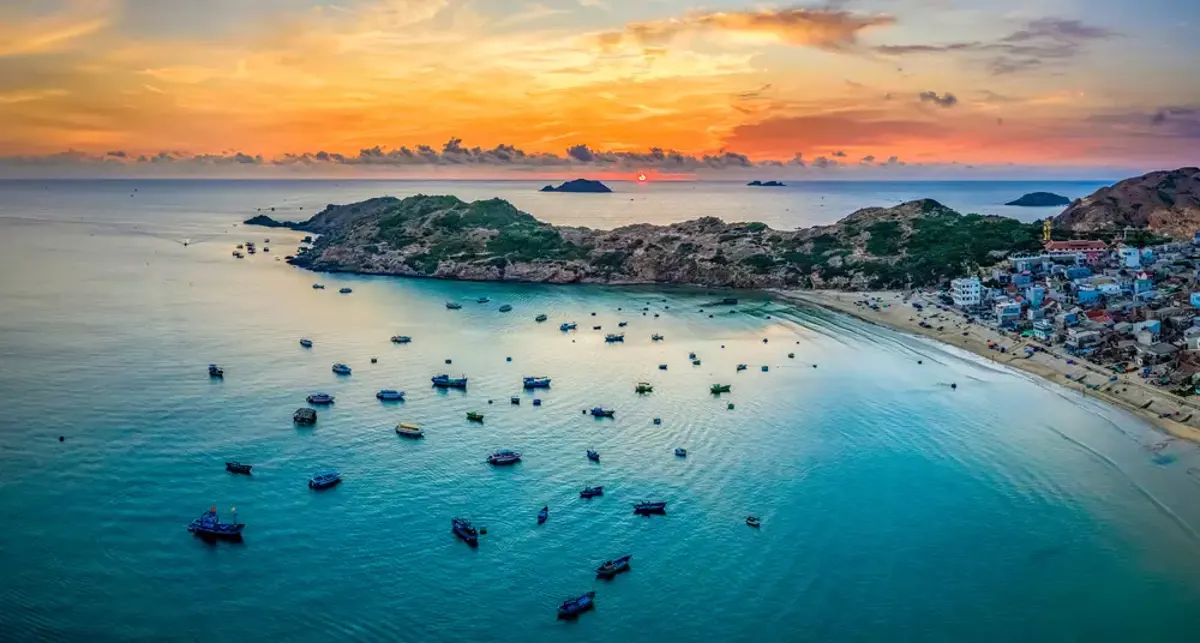
Cu Lao Xanh, also identified as Van Phi Island, represents a significant natural feature off the coast of Quy Nhon City in Binh Dinh Province, Vietnam. Situated approximately 24 kilometers from the mainland, this island is part of Nhon Chau Commune and is recognized for its verdant landscapes and clear coastal waters. This guide offers practical information for domestic travelers interested in visiting this distinct location.
Understanding Cu Lao Xanh Island
Cu Lao Xanh translates to "Green Islet," a name reflecting its abundant natural foliage and lively environment. The island is characterized by dense natural forests and lines of tall coconut trees that border the shoreline. The sky above is typically clear blue, complementing the remarkably transparent sea. Sunlight often creates a shimmering effect on the water's surface, enhancing the island's visual appeal.
The island features soft, white sand formations. From an elevated perspective, Cu Lao Xanh appears as a graceful form amidst the expansive ocean. For those planning an itinerary that includes Quy Nhon, Cu Lao Xanh is often suggested as a worthwhile addition to a travel plan.
Optimal Times to Visit Cu Lao Xanh
Cu Lao Xanh experiences a tropical climate typical of Vietnam's South Central region, sharing characteristics with coastal areas like Nha Trang or Phu Yen. The most favorable period for a trip to this island is generally from February to June or during September and October. During these months, the island typically enjoys consistent sunshine and an average temperature around 28°C, which is suitable for water activities such as swimming and exploring coral reefs.
Conversely, late July and August are generally not recommended for visits due to an increased likelihood of typhoons. This period often brings strong northeast monsoons, resulting in rainfall and turbulent sea conditions, which can lead to disruptions in boat services. Travelers are advised to avoid visiting during adverse weather to prioritize safety.
Activities and Attractions on Cu Lao Xanh
The island's western side hosts several appealing beaches, suitable for individuals interested in swimming, enjoying transparent waters, observing diverse coral formations, and strolling along extensive stretches of soft white sand. Those who appreciate marine environments may find these beaches particularly engaging. Additional activities include searching for starfish or collecting sea urchins. For those interested in similar coastal experiences, exploring Halong Bay's best beaches might offer further inspiration.
Cu Lao Xanh Light Station and Lighthouse
Perched atop a 120-meter hill, the Cu Lao Xanh Light Station stands alongside a 19-meter lighthouse. The light station building, a two-story structure with a distinctive design, reportedly served as a residence for a French official during the period of French colonial rule. Behind the light station, the 19-meter lighthouse, known by its French designation Plogam Bir, combines elements of Asian and Western Gothic architectural styles. Its construction dates back to 1890, initiated after a vessel reportedly collided with a reef in the Quy Nhon sea. Upon its completion, this structure was considered the tallest lighthouse in Indochina, measuring 119 meters in length and projecting light up to 50 kilometers. For over 130 years, the Cu Lao Xanh Lighthouse has provided guidance to fishing boats and local fishermen, assisting them in navigating safely at night and through challenging sea conditions. From the summit of the lighthouse, visitors can observe expansive views of Cu Lao Xanh island, revealing a broad panorama of blue and green hues.
"Fairy Well" Stream (Giếng Tiên)
Travelers can proceed northwest from the lighthouse to reach the "Fairy Well" Stream, or Giếng Tiên. Its name originates from a local narrative suggesting that on moonlit evenings, celestial beings would descend to the stream, enjoy the surroundings, bathe in its waters, and then return to the heavens. In Vietnamese, "Giếng" signifies "well" and "Tiên" means "fairy," thus Giếng Tiên refers to the well where fairies are said to have bathed. Experiencing the fresh water, which carries a hint of salinity, is often highlighted as a memorable activity for visitors.
Cầu Ngư Festival
The Cầu Ngư Festival, meaning "fish worshipping," is a significant traditional event for fishing communities in coastal regions, including Cu Lao Xanh. This festival is observed annually on the 16th day of the third lunar month. Its purpose is to express gratitude to the "fish lord" and to seek blessings for a safe and prosperous fishing season, acknowledging the inherent risks faced by fishermen at sea. This spiritual custom has been passed down through generations and continues to be honored. Beyond the ceremonial rituals, the festival features various traditional games, such as boat races and tug-of-war.
Other Activities
Visitors might consider bringing fishing equipment when exploring the Cu Lao Xanh Island. After walking or swimming, individuals can fish from rocky outcrops or wade into the water to gather "vú nàng" snails, a local culinary item. Enjoying freshly caught seafood, perhaps grilled on-site with companions, is a popular activity. The island also has small sand dunes where sea turtles are known to lay eggs. Occasionally, a visitor might witness young turtles making their way towards the ocean.
Accommodation Options on the Island
Cu Lao Xanh is recognized for its natural and serene beaches, which have not been extensively developed for tourism. Consequently, the range of accommodation choices for visitors is somewhat limited. Several homestays are available, with prices typically ranging from 50,000 VND to 100,000 VND per person, or 150,000 VND to 550,000 VND per room, depending on individual budget and preferences.
Named homestay options include:
- Homestay Travel Cu Lao Xanh
- Uncle Nam’s Homestay in Hoa Hoa
- Uncle Vuong’s Homestay
- Phuc Hung Homestay
- Homestay Ngoc Dinh
Beyond these established homestays, travelers seeking a more direct local experience may inquire about staying with residents. The local people and fishermen on the island are generally described as welcoming and willing to assist, sometimes offering simple meals featuring local seafood and specialties. Such interactions often provide insights into unique aspects of Vietnamese culture and daily life.
Reaching Cu Lao Xanh Island
As an area under strict maritime management within Vietnam's national boundaries, access to Cu Lao Xanh is restricted for foreign nationals. For domestic travelers, the only methods to reach this island, located 24 kilometers from Quy Nhon, are by boat or speedboat from Ham Tu wharf.
Travelers have two primary options for sea transport:
- Normal Wooden Boat: This option typically takes approximately 2 hours and costs 25,000 VND. (Prices should be verified by the reader at the time of travel).
- High-Speed Boat: A quicker alternative, this journey lasts about 50 minutes and costs 200,000 VND. (Prices should be verified by the reader at the time of travel).
For those considering other modes of transport across Vietnam, information on overnight rail journeys can be helpful. The island is known for its natural beauty, featuring sunny beaches and a tranquil coastline.
| Transport Type | Estimated Travel Time | Estimated Cost (VND) | Notes |
|---|---|---|---|
| Normal Wooden Boat | 2 hours | 25,000 | Slower, more economical. |
| High-Speed Boat | 50 minutes | 200,000 | Faster, higher cost. |
Current prices and schedules should be verified locally prior to travel.
Important Travel Considerations for Cu Lao Xanh
Cu Lao Xanh functions as a military island, which means security protocols are stringent. Visitors are required to carry identification documents upon arrival. It is explicitly stated that foreign nationals are currently prohibited from visiting Cu Lao Xanh for any reason.
The island's electricity supply is not yet connected to the mainland grid. Residents rely on generators, which operate daily from 9 am to 3 pm and again from 5 pm to 11 pm. Travelers should therefore plan accordingly by bringing portable chargers for electronic devices such as cameras and phones to avoid power depletion.
The combination of clean air, clear waters, light-colored sands, and abundant sunshine contributes to the serene and natural environment of Cu Lao Xanh, making it a distinctive destination within the Quy Nhon area.
Frequently Asked Questions
What is the primary appeal of Cu Lao Xanh?
Cu Lao Xanh is primarily valued for its untouched natural beauty, including clear blue waters, white sand beaches, and lush green landscapes, offering a peaceful retreat from more developed tourist areas.
Can international visitors travel to Cu Lao Xanh?
No, according to current regulations, foreign nationals are prohibited from visiting Cu Lao Xanh, as it is designated as a military island with strict security measures.
What are the best activities to do on Cu Lao Xanh?
Popular activities include swimming and diving in the clear waters, exploring the historic Cu Lao Xanh Lighthouse, visiting the "Fairy Well" Stream, participating in local fishing, and potentially observing the annual Cầu Ngư Festival (March 16th lunar calendar).
What kind of accommodation is available on the island?
Accommodation on Cu Lao Xanh mainly consists of homestays, offering a local experience. Prices typically range from 50,000 VND to 100,000 VND per person or 150,000 VND to 550,000 VND per room.
How reliable is the electricity supply on Cu Lao Xanh?
Electricity on the island is supplied by generators, operating from 9 am to 3 pm and 5 pm to 11 pm daily. Visitors should prepare backup power sources for their electronic devices.








