
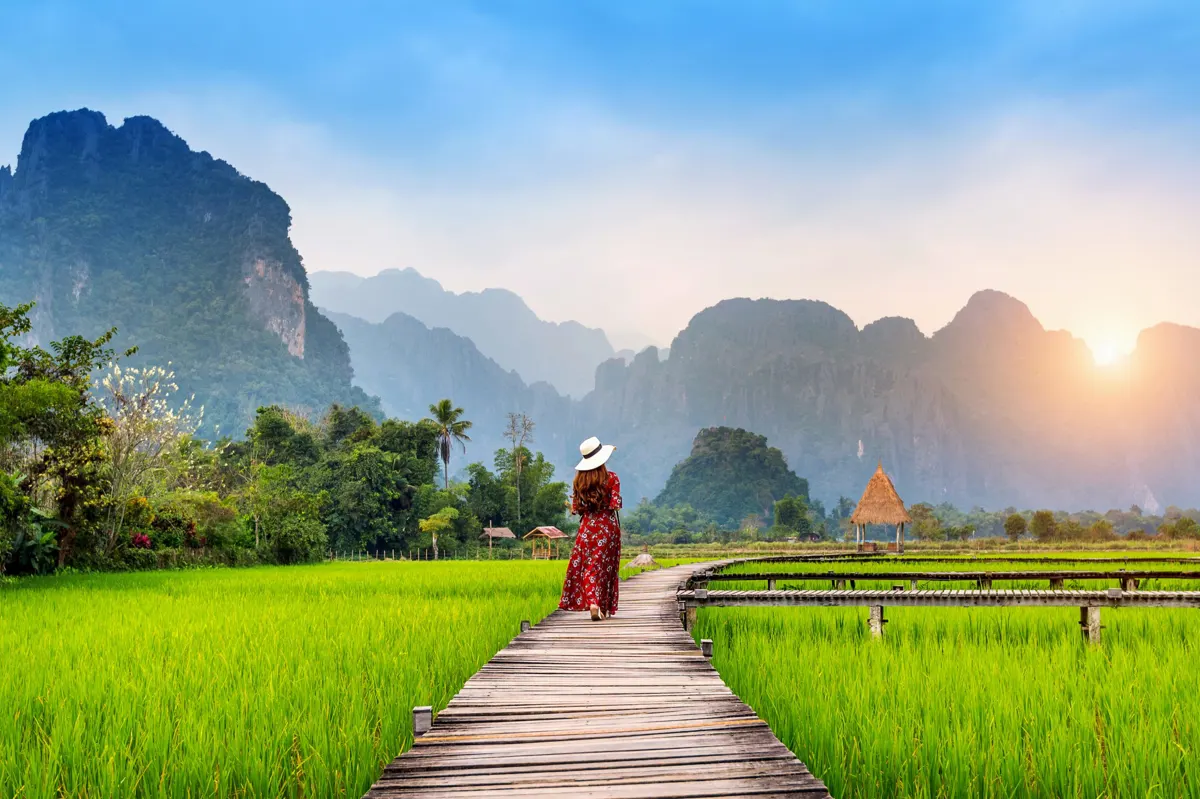
Laos, a landlocked nation in Southeast Asia, shares borders with Vietnam, Cambodia, Thailand, Myanmar, and China. Known for its tropical environment, the country welcomes visitors throughout the year to experience its distinct culture, traditions, cuisine, and spiritual sites. For those considering a trip to this part of Asia, understanding a few key aspects can significantly enhance the travel experience.
Understanding Laos's Climate and Optimal Travel Periods
Before any vacation, checking the local weather conditions is always advisable. Laos experiences a tropical climate characterized by two main seasons: the wet season, which typically runs from May to October, and the dry season, spanning November to April. Temperatures can become quite high, often exceeding 35 degrees Celsius, particularly from late January through May, a period also marked by substantial rainfall.
The most favorable time for a visit to Laos is generally considered to be from November to February. During these months, rainfall is less frequent, and temperatures are more moderate, usually staying below 30 degrees Celsius. Travelers planning to visit during the rainy season should anticipate potential delays, as some roads in Laos may become less accessible or require alternative routes due to heavy precipitation, occasionally necessitating waits for the rain to subside.
Visa Requirements for Entry into Laos
Most international visitors to Laos will need to obtain a tourist visa, unless their country is a member of ASEAN. The process for acquiring a visa is generally straightforward and convenient. With the exception of certain nations in Africa and the Middle East, citizens from most other countries are eligible for a visa on arrival.
Upon reaching a Laotian border crossing, travelers can complete a form, pay the required fee, and typically receive their 30-day tourist visa within a few minutes. The cost for a 30-day tourist visa ranges from 30 to 42 US dollars, depending on the traveler's nationality. An additional charge of 1 to 2 US dollars may apply if passport-sized photographs are not provided. Citizens from ASEAN member states, Japan, Russia, Switzerland, and South Korea are granted a 30-day visa-free entry. The visa-on-arrival procedure is usually efficient, often taking less than ten minutes.
Managing Finances: Currency and Accommodation in Laos
The primary currency used in Laos is the Kip (LAK). Foreign currencies such as the US dollar or Euro are not widely accepted for daily transactions, making it necessary to exchange money. The Kip has a low value relative to major international currencies; for instance, 1 US dollar is approximately equivalent to 0.00012 LAK, and 1 Euro to 0.000102 LAK. Visitors should not be surprised by large numerical values on price tags, such as a 20,000 LAK sandwich.
It is recommended to exchange some currency in your home country before arriving and to perform further exchanges at established banks within Laos, rather than unofficial money changers. Regarding accommodation, options in Laos are typically quite affordable. A bed in a dormitory can be found for approximately 5 to 9 US dollars per night, while a private room with air conditioning usually costs between 13 and 18 US dollars. For basic, secure lodging, a budget of around 10 US dollars per night is often sufficient. Many city hotels and hostels provide complimentary breakfast and Wi-Fi. Those seeking more amenities, such as a swimming pool, can expect to pay from 45 US dollars per night. Overall, finding reasonably priced lodging in Laos is generally uncomplicated.
Exploring Laotian Cuisine and Hydration Tips
Laotian food can be somewhat more expensive compared to neighboring countries, largely due to a greater reliance on imported goods and less extensive local farming. Nevertheless, dining costs remain quite manageable for travelers. Street food is a popular and economical choice in urban areas, with dishes typically costing around 2 to 3 US dollars. Western-style meals are usually priced from 5 US dollars upwards. For a mid-range dining experience in a restaurant, prices will be higher.
A daily food budget of approximately 15 US dollars, combining street food and occasional Western meals, is generally sufficient to ensure satisfying meals. A critical health consideration for visitors is water consumption: tap water in Laos is not considered safe for drinking. It is strongly advised to purchase bottled water or consume beverages from reputable cafes and restaurants.
Transportation Options Within Laos
Traveling between cities and towns in Laos is often best accomplished by bus, offering an economical, convenient, and relatively comfortable option. A bus journey lasting five to six hours typically costs between 10 and 13 US dollars. For longer distances or overnight travel, sleeper buses are available, with fares ranging from 15 to 20 US dollars, depending on the route length. While Vietnam offers overnight rail journeys, Laos relies primarily on its road network for intercity travel.
For local transportation within cities or villages, options are also very affordable. Prices for local transport can start from as low as 0.5 US dollars, increasing with distance. Taxis and tuk-tuks provide convenient alternatives, though they are slightly more expensive. It is advisable to consult hotel staff for estimated fares for specific routes. For those comfortable riding motorbikes, daily rentals are available for 7 to 10 US dollars, providing flexibility for independent exploration.
Key Destinations and Experiences in Laos
Laos offers numerous noteworthy locations for visitors. A visit to Luang Prabang is frequently recommended; this city was designated a UNESCO World Heritage site in 1995 and is celebrated for its architectural heritage and numerous temples. Activities in Luang Prabang include exploring the night market, observing the traditional Tak Bat (alms giving ceremony), and experiencing authentic Laotian massage.
Other significant urban centers include Vientiane, the capital, Vang Vieng, known for its natural surroundings, and Pakbeng, often a stopover point for river journeys. Beyond its cultural sites, Laos is also rich in natural beauty. The country features untouched landscapes such as the waterfall-rich Bolaven Plateau, the scenic Thakhek Loop motorbike route, the tranquil 4000 Islands region, and ancient ruined temples situated near Champasak Province. These areas provide opportunities for independent exploration or guided tours.
Frequently Asked Questions
What is the best time to visit Laos?
The most favorable period to visit Laos is from November to February. During these months, the weather is generally cooler, with temperatures typically below 30 degrees Celsius, and there is less rainfall, making travel more comfortable.
Is tap water safe to drink in Laos?
No, tap water in Laos is not considered safe for direct consumption. Travelers should always opt for bottled water or beverages from trusted establishments to ensure safety and prevent health issues.
What currency is used in Laos, and how should I manage my money?
The official currency of Laos is the Kip (LAK). It is advisable to exchange some foreign currency, such as US dollars or Euros, into Kip before or upon arrival. Currency exchange should ideally be done at banks rather than unofficial markets. Understanding banking services in Hanoi or other major Southeast Asian cities can also provide context for managing finances abroad.
How much does a visa on arrival for Laos typically cost?
A 30-day tourist visa on arrival for Laos generally costs between 30 and 42 US dollars, depending on the traveler's nationality. An additional fee of 1 to 2 US dollars may be charged if passport-sized photos are not brought along.
Is accommodation expensive in Laos?
Accommodation in Laos is generally quite affordable. Dormitory beds can be found for 5-9 US dollars per night, and private rooms with air conditioning typically range from 13-18 US dollars. Even hotels with additional amenities like pools can be found starting from around 45 US dollars per night.








