
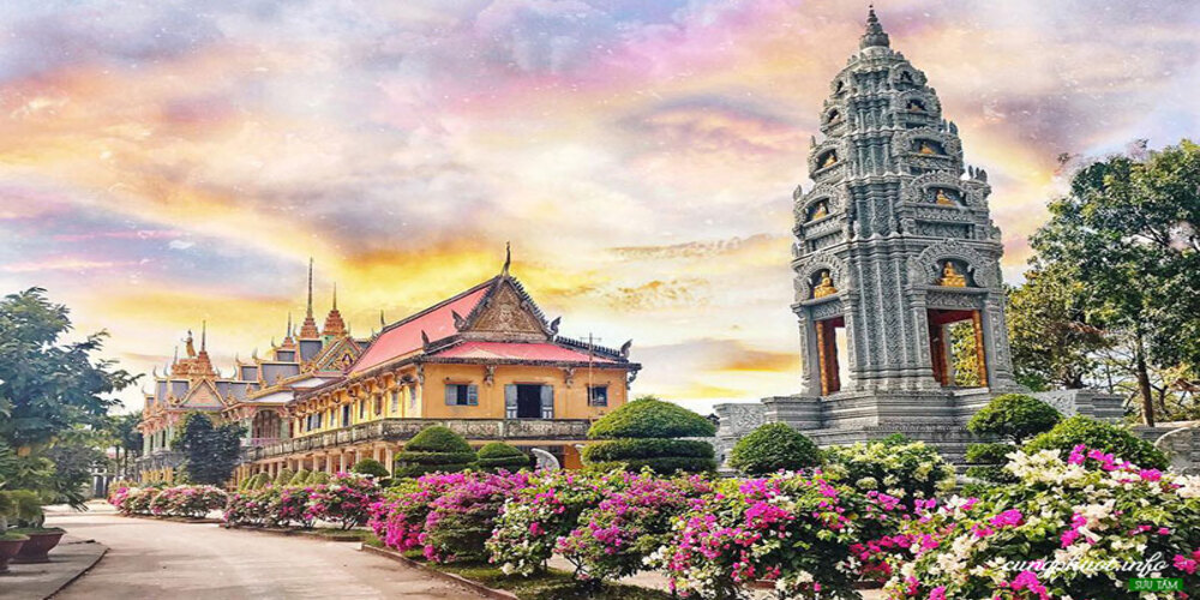
Bat Pagoda, officially named Mahatúp Pagoda, stands as a notable religious site in Soc Trang Province, Vietnam. It is recognized for its distinctive architectural elements and serves as the sole temple where the local Khmer community observes the teachings of Shakyamuni Buddha. The pagoda derives its common name from the thousands of large bats, or flying foxes, that inhabit its extensive grounds.
The Historical Background of Bat Pagoda
Historical records indicate that the pagoda was originally established in 1569. Over subsequent centuries, it underwent numerous renovations and enhancements. A significant refurbishment of the main sanctuary occurred in 1960, contributing to its more ornate appearance.
In 1999, Bat Pagoda received official recognition as a national cultural and historical relic site, underscoring its importance. Unfortunately, a fire in 2008 caused extensive damage, completely destroying the main sanctuary. Reconstruction efforts began in April 2009, aiming to restore the structure to its original design. Since 2013, the site has been accessible to the public, consistently drawing a considerable number of visitors annually. A spacious parking area is available at the front of the complex, with various visitor services located nearby.
Architectural Styles and Cultural Significance
Bat Pagoda is widely considered a tranquil location, characterized by its verdant surroundings and the presence of thousands of large flying foxes. The temple complex features three primary structures: the central sanctuary, the Sala house, and an altar dedicated to Mr. Thach Chia, who played a crucial role in the pagoda's restoration. All these buildings showcase traditional Khmer architectural styles.
The main sanctuary's interior is adorned with intricate patterns and illuminated by an artistic representation of Shakyamuni Buddha achieving nirvana. The roof is notable for its elaborate carvings, depicting the semi-divine serpent Naga, while images of the fairy Kemnar are positioned between the roof and its supporting elements. Inside the principal worship area, a two-meter statue of Shakyamuni Buddha rests upon a 1.5-meter elevated platform. Visitors can observe detailed carvings illustrating key moments from Shakyamuni Buddha's life, from his birth to his enlightenment. After exploring the main sanctuary, guests typically proceed to the Sala house, situated on the opposite side. This building serves as a resting place for monks and a reception area for guests. Here, visitors might observe local children performing traditional Khmer musical instruments, showcasing their skill and cultural heritage. To learn more about the broader cultural context of the region, consider visiting the Khmer Museum in Soc Trang.
The Unique Flying Fox Colony
Beyond its distinctive and elaborate architecture, Bat Pagoda attracts many visitors due to the fascinating stories and presence of its flying fox colony. The most remarkable aspect is the sheer number of these large bats residing within the pagoda's grounds. They are typically observed sleeping during daylight hours, then departing at night to forage for food.
Local residents hold a belief that these bats bring good fortune to their families and therefore regard them with reverence, almost like household companions. This specific species of bat usually weighs between one and 1.5 kilograms and can have a wingspan of approximately 1.5 meters. Their fur is a combination of blonde and black hues. Although they are herbivores, these flying foxes reportedly do not consume fruits from the pagoda's own gardens, preferring to seek sustenance further afield. During the day, they cling to tree branches within the garden, often appearing like clusters of fruit, which many observers find quite captivating. The presence of these animals adds a unique natural element to the spiritual site, making it a point of interest for both cultural and wildlife enthusiasts.
Planning Your Visit to Bat Pagoda
Reaching Bat Pagoda from Ho Chi Minh City involves a two-step journey. First, travelers should take a bus from Mien Tay Bus Station, located at 395 Kinh Duong Vuong Street, An Lac Ward, Binh Tan District, to Soc Trang City. Multiple bus services operate on this route. Upon arrival in Soc Trang City, the pagoda is accessible via taxi or motorbike taxi, situated on Van Ngoc Chinh Street, Ward 3. For those unfamiliar with independent travel in the region, arranging a guided tour that includes Bat Pagoda and other local attractions can simplify logistics and provide additional insights into the area's history and culture. Such tours are available from various operators in Ho Chi Minh City and can sometimes be customized. For a broader overview of the area, consult a Soc Trang travel guide.
For a comprehensive experience of the Mekong Delta, including cultural sites like Bat Pagoda, consider an organized trip. A Vietnam & Cambodia cultural journey often incorporates visits to key regional attractions, providing a structured way to explore the area's heritage.
Practical Information for Visitors
- Address: Van Ngoc Chinh Street, Ward 3, Soc Trang City, Soc Trang Province, Vietnam
- Opening Hours: The site has been open to the public since 2013 (verify current hours locally upon arrival).
- Admission: Not specified in source (verify locally).
- Getting There from Ho Chi Minh City: Take a bus from Mien Tay Bus Station (395 Kinh Duong Vuong Street, An Lac Ward, Binh Tan District) to Soc Trang City. From Soc Trang City, take a taxi or motorbike taxi to the pagoda.
- Tour Options: Guided tours from Ho Chi Minh City are available and can offer convenience and cultural context.
Frequently Asked Questions
What is Bat Pagoda also known as?
Bat Pagoda is also widely referred to as Mahatúp Pagoda. This name reflects its formal designation within the Khmer Buddhist tradition.
Why is it called Bat Pagoda?
The pagoda earned its common name, Bat Pagoda, due to the substantial population of large bats, specifically flying foxes, that reside within its extensive grounds and surrounding trees.
What kind of architecture can be seen at Bat Pagoda?
The structures at Bat Pagoda, including the main sanctuary and Sala house, exhibit traditional Khmer architectural styles. These are characterized by elaborate carvings, such as the Naga serpent on the roof and the fairy Kemnar figures.
Are the bats at Bat Pagoda dangerous?
The flying foxes at Bat Pagoda are herbivores and are generally observed sleeping during the day. Locals believe they bring good fortune and treat them with respect. They are not reported to be aggressive or dangerous to visitors.
How far is Bat Pagoda from Ho Chi Minh City?
Bat Pagoda is located in Soc Trang City, Soc Trang Province. The journey from Ho Chi Minh City involves a bus ride to Soc Trang City, followed by a local taxi or motorbike taxi to the pagoda itself. The total distance and travel time can vary depending on traffic and specific bus routes.








