
Ho Chi Minh City, while a dynamic and contemporary urban center in Vietnam, remarkably maintains a quiet charm through its preserved historical structures. Over more than three centuries of growth, the city, once known as Saigon, has evolved into a major commercial hub. Despite this modernization, the profound influence of French colonization, spanning from 1884 to 1954, remains evident in numerous architectural sites. These buildings, many over a century old, now serve as popular attractions, inviting visitors to observe their design and understand the history of a place once referred to as the “Pearl of the Far East.”
These French-era buildings provide a unique contrast to the city's modern pace, standing as testaments to a different era. From grand public buildings to former private residences and places of worship, each site tells a part of Ho Chi Minh City's story, reflecting a fusion of European design principles with local context. Exploring these landmarks offers an engaging way to connect with the city's layered past and appreciate its diverse cultural heritage.
Ho Chi Minh City's Colonial Architectural Legacy
The architectural landscape of Ho Chi Minh City is significantly shaped by its colonial past, with many structures reflecting French design principles from the late 19th and early 20th centuries. These buildings often incorporate a blend of Gothic, Neo-Roman, Renaissance, and Art Deco styles, adapted to the local climate and materials. The period of French rule left an indelible mark, transforming Saigon into a city with wide boulevards and grand public edifices that mirrored those found in France.
Beyond their aesthetic appeal, these buildings represent a crucial period in Vietnamese history. They were constructed for various purposes, including administrative offices, religious institutions, commercial centers, and private residences for the colonial elite. Today, many continue to serve their original functions or have been repurposed as museums and cultural centers, allowing contemporary visitors to engage directly with this historical layer of the city.
Key French Colonial Architectural Sites
Visitors to Ho Chi Minh City have the opportunity to explore a range of buildings that showcase French colonial architecture. Each site possesses distinct characteristics and a unique history, contributing to the city's rich cultural fabric. From grand cathedrals to functional markets, these structures offer varied perspectives on the era.
- Notre Dame Cathedral: Located at No. 1 Cong Xa Paris Street, District 1. Constructed between 1863 and 1880, this cathedral is a notable example of French design, featuring Gothic and Neo-Roman influences. Its structure uses locally quarried granite, covered with red tiles imported from Marseilles. The two bell towers reach 57.6 meters, topped by a 3.5-meter crucifix, bringing the total height to 60.5 meters. As of the last update, the cathedral is undergoing renovation, restricting interior access, though the front plaza and its 1959 statue of Mary remain accessible.
- Central Post Office: Situated at No. 2 Cong Xa Paris Street, District 1. Built from 1886 to 1891, this building displays Gothic and Renaissance architectural elements. Designed by Alfred Foulhoux, it features a bright yellow exterior with white trim, arched windows, wooden shutters, and marble floors. Inside, visitors can observe domed ceilings, metal arches, and two large hand-painted maps depicting old Saigon and former Indochina from the early 1900s. It remains a fully operational post office, offering services and souvenirs.
- Saigon Opera House (Municipal Theatre): Found at No. 7 Cong Truong Lam Son Street, District 1. Designed by French architect Eugene Ferret and completed in 1898, this ornate building was initially an entertainment venue for French colonists. Today, it hosts performances, including the popular AO Show, and is generally open to the public only during these events.
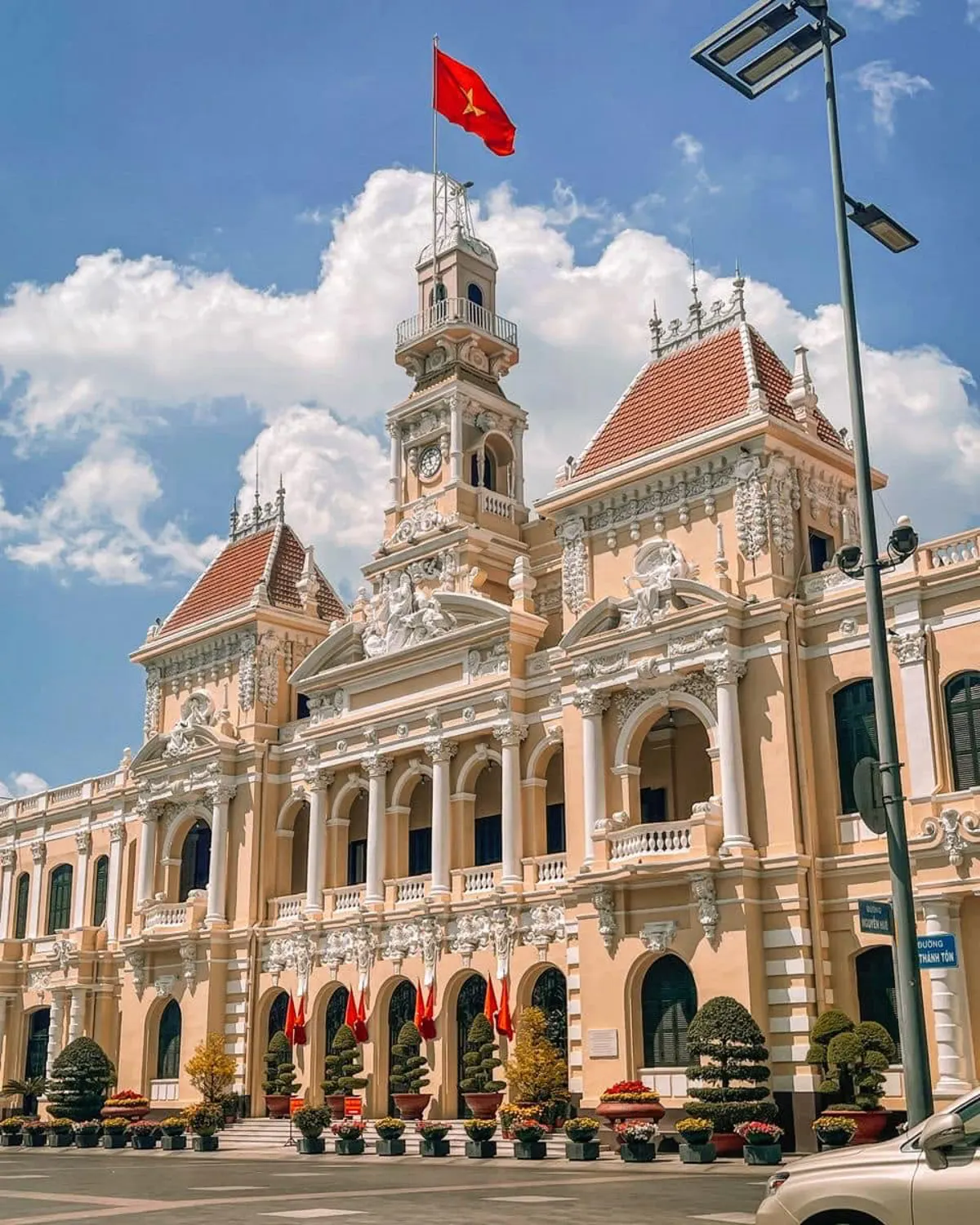
- People’s Committee Building (Saigon City Hall): Located at 86 Le Thanh Tong Street, District 1. Constructed between 1897 and 1908 by Femand Gardes, this building was modeled after the City Hall in Paris. It features a symmetric design with a central bell tower and intricate bas-reliefs. While it serves as a government office and is not accessible to tourists inside, photography of its exterior, including the statue of Ho Chi Minh erected in 2015, is permitted. The building is illuminated at night.
- Reunification Palace: Address is 135 Nam Ki Khoi Nghia Street, District 1. Originally Norodom Palace, built from 1868 to 1871 by Achille-Antoine Hermitte, this site underwent significant reconstruction after being bombed in 1962, with a new design by Vietnamese architect Ngo Viet Thu. It became known as Independence Palace and later Reunification Palace. Today, it functions as a museum, providing insights into the lifestyle of South Vietnam's former bureaucratic elite and historical details of the war.
- Hotel Continental Saigon: Located at the corner of Cong Truong Lam Son Street & Hai Ba Trung Street, District 1. Completed in 1886, this is one of the city’s oldest hotels. It is known for its association with author Graham Greene, whose novel “The Quiet American” features the hotel prominently. It retains much of its original character.
- Ho Chi Minh City Museum of Fine Arts: Situated at 97A Pho Duc Chinh Street, District 1. This building, designed by French architect Mr. Rivera, was constructed between 1929 and 1934 as a private villa before becoming a museum in 1987. It showcases a blend of Asian and European architectural styles.
- Ben Thanh Market: Found at the intersection of Le Loi, Ham Nghi, Tan Hung and Le Lai Streets, District 1. While its origins trace back to the 17th century, the current Art Deco-style building, designed by Brossard and Mopin, was completed in 1912. It features a large 28-meter dome and a prominent belfry. The market is a major commercial hub, housing approximately 1,500 sellers. In the evenings, the streets around its west and east gates transform into a night market. For those interested in local goods, exploring the diverse array of local products can be a rewarding experience.
- Hotel Majestic Saigon: Address is 1 Dong Khoi Street, District 1. Built in 1925, this five-star hotel overlooks the Saigon River. Also designed by Mr. Rivera, it features a distinctive large arched roof extending over the sidewalk, gold embellishments, and individual balconies. It is another location where Graham Greene reportedly wrote parts of “The Quiet American.”
- Dragon Wharf – Ho Chi Minh Museum: Located at 1 Nguyen Tat Thanh Street, District 4. Constructed from 1862 to 1863, this was the city's first commercial port. Its architecture combines French and Vietnamese elements, notably two dragon statues on its roof. On June 5, 1911, Ho Chi Minh (then Nguyen Tat Thanh) departed from this wharf. Since 1979, it has served as a museum, displaying artifacts and documents related to his life.
- Tan Dinh Church: Found at 289 Hai Ba Trung Street, District 3. This is the second-largest church in the city, belonging to the Roman Catholic Archdiocese of Ho Chi Minh City. It combines Gothic and Renaissance styles, standing over 60 meters tall with two bell towers. Known for its distinctive pink exterior, it underwent renovations in 1976.
- Phuong Nam Mansion: Situated at 110-112 Vo Van Tan Street, District 3. This privately owned mansion, built between 1924 and 1927 by a wealthy Vietnamese gem dealer, is a less public but significant heritage building. It displays a French style with an Eastern touch on its exterior and is furnished with luxurious antiques inside. While visitors can view the exterior for a small fee, interior access is not permitted.
Practical Information for Visiting Architectural Landmarks
When planning to visit Ho Chi Minh City's colonial architectural sites, understanding access, location, and general tips can enhance the experience. Many of these buildings are concentrated in District 1, making it feasible to visit several on foot or with short taxi rides. Public transportation options are also available, and for travelers managing their finances, navigating banking services in Ho Chi Minh City is straightforward with numerous local and international institutions.
It is advisable to check current operating hours and access restrictions for each site, as some, like the Notre Dame Cathedral, may be undergoing renovations, or others, like the People's Committee Building, are active government offices with limited public entry. For sites that function as museums or performance venues, such as the Reunification Palace or the Saigon Opera House, ticket purchases may be required for entry or specific events. Always carry local currency for any entrance fees or small purchases.
Comparing Ho Chi Minh City's Architectural Highlights
| Site Name | Address | Primary Architectural Style | Public Access Notes |
|---|---|---|---|
| Notre Dame Cathedral | No. 1 Cong Xa Paris Street, District 1, HCM City | Gothic, Neo-Roman | Exterior and front plaza accessible; interior currently closed for renovation. |
| Central Post Office | No. 2 Cong Xa Paris Street, District 1, HCM City | Gothic, Renaissance | Fully functional post office; interior accessible. |
| Saigon Opera House | No. 7 Cong Truong Lam Son Street, District 1, HCM City | French Colonial | Interior accessible during performances (e.g., AO Show). |
| People’s Committee Building | 86 Le Thanh Tong Street, District 1, HCM City | French Colonial (Paris City Hall model) | Exterior viewing and photography allowed; interior not accessible (government office). |
| Reunification Palace | 135 Nam Ki Khoi Nghia Street, District 1, HCM City | Modernist (post-1962 rebuild) | Museum; interior accessible with ticket. |
| Hotel Continental Saigon | Corner of Cong Truong Lam Son Street & Hai Ba Trung Street, District 1, Ho Chi Minh City | French Colonial | Hotel; accessible to guests and for dining/drinks. |
| Ho Chi Minh City Museum of Fine Arts | 97A Pho Duc Chinh Street, District 1, Ho Chi Minh City | Asian-European blend (French influence) | Museum; interior accessible with ticket. |
| Ben Thanh Market | at the intersection of Le Loi, Ham Nghi, Tan Hung and Le Lai Streets, District 1, HCM City | Art Deco | Market; interior fully accessible during operating hours. Night market outside. |
| Hotel Majestic Saigon | 1 Dong Khoi Street, District 1, HCM City | French Colonial | Hotel; accessible to guests and for dining/drinks. Rooftop bar. |
| Dragon Wharf – Ho Chi Minh Museum | 1 Nguyen Tat Thanh Street, District 4, HCM City | Vietnamese-French blend | Museum; interior accessible with ticket. |
| Tan Dinh Church | 289 Hai Ba Trung Street, District 3, HCM City | Gothic, Renaissance | Church; exterior accessible, interior access may vary based on services. |
| Phuong Nam Mansion | 110-112 Vo Van Tan Street, District 3, Ho Chi Minh City | French Colonial (with Eastern elements) | Exterior view for a small charge; interior not accessible (private property). |
Frequently Asked Questions
What is the best way to explore Ho Chi Minh City's French colonial architecture?
Many of the significant French colonial buildings are located within District 1, making walking tours a practical option for exploring several sites in close proximity. Alternatively, taxis or ride-sharing services can be used to reach more distant locations efficiently. Consider starting with the cluster around Cong Xa Paris Street, which includes the Notre Dame Cathedral and Central Post Office.
Are there any entrance fees for these architectural sites?
Entrance fees vary by site. Public buildings like the Central Post Office or the exterior of the People's Committee Building generally do not have an entry charge. However, museums such as the Reunification Palace or the Ho Chi Minh City Museum of Fine Arts, and performance venues like the Saigon Opera House (during events), typically require a ticket for entry. Phuong Nam Mansion charges a small fee for exterior viewing.
Can visitors enter all of the French colonial buildings?
No, not all buildings are accessible to the public. The People's Committee Building, for instance, is an active government office and its interior is off-limits to tourists, though exterior photography is permitted. The Notre Dame Cathedral is currently undergoing renovations, limiting interior access. Privately owned properties like Phuong Nam Mansion also restrict interior entry. It is always best to check specific access policies for each site before visiting.
What is the historical significance of these French colonial buildings?
These buildings are significant because they represent a tangible link to Vietnam's colonial past and the period of French influence. They showcase European architectural styles adapted to the local environment and often played crucial roles in the administration, culture, and daily life of Saigon during the colonial era. Today, they serve as important historical landmarks, museums, and cultural centers, preserving a vital part of the city's heritage.
Are there guided tours available for these architectural sites?
Yes, many local tour operators offer guided tours that focus on Ho Chi Minh City's historical and architectural landmarks, including its French colonial buildings. These tours can provide deeper insights into the history and significance of each site, often with knowledgeable guides. It is recommended to book tours in advance, especially during peak travel seasons.








