
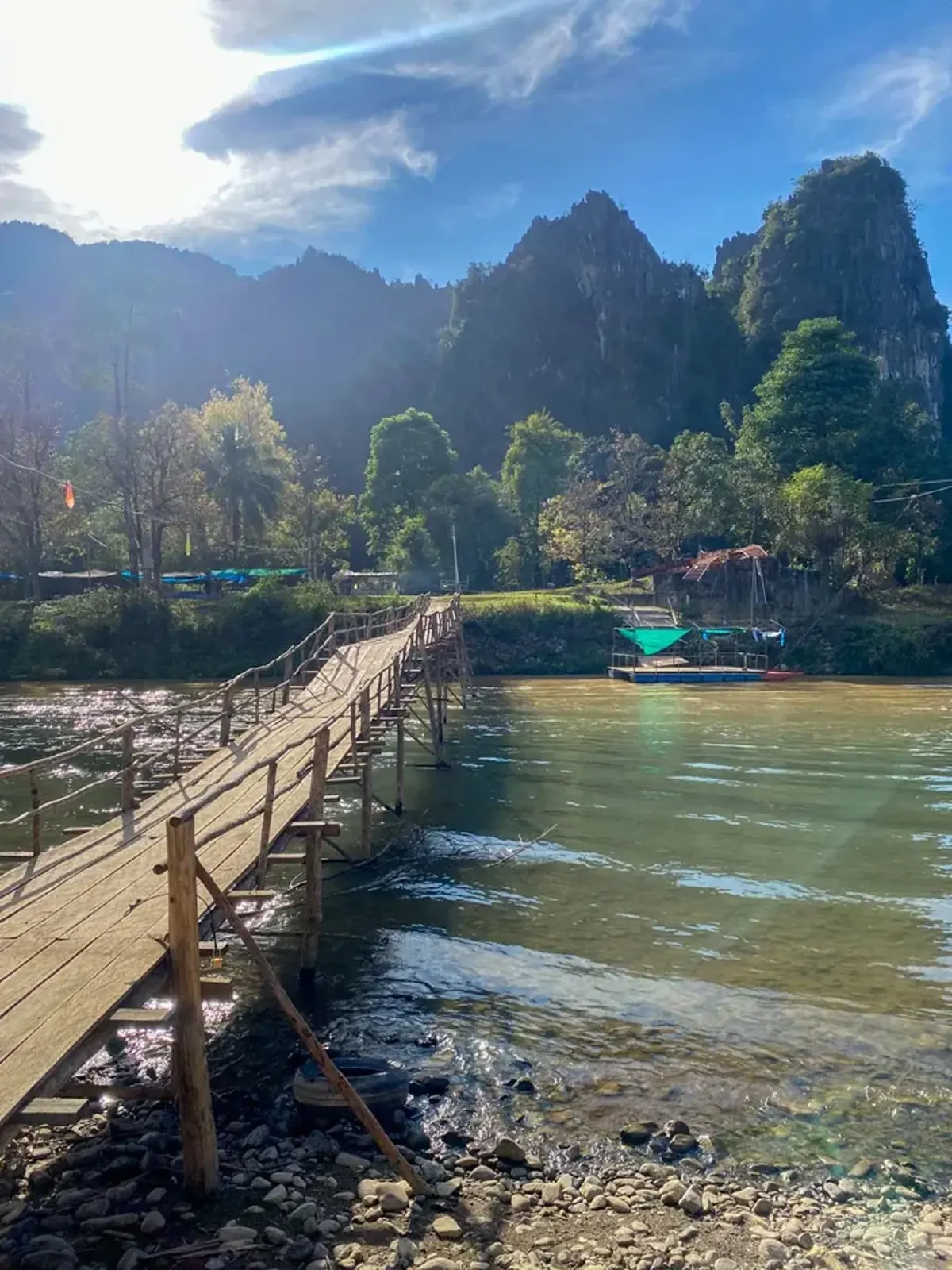
Laos, a landlocked nation in Southeast Asia, offers a distinct travel experience characterized by serene landscapes and a relaxed way of life. For those considering a visit, understanding key practicalities from visas to local transport is crucial for a smooth journey. This guide provides essential information to help prepare for a trip to this captivating country.
Climate and Optimal Travel Periods in Laos
Laos experiences a generally mild climate without coastal storms, with variations influenced by altitude and terrain. The northern mountainous regions tend to be cooler, while the southern delta plains are warmer and more humid. The country's climate can be broadly categorized into two main seasons, with average temperatures around 29°C, occasionally falling to 15-20°C during cooler months.
The wet season typically spans from May to October, marked by intermittent rain showers that usually last for a few hours every few days, rather than continuous downpours. This period is often referred to as the "green season" due to the verdant landscapes that emerge across the country. Despite the rain, clear skies are common, making it a viable time for travel, though humidity can be high, particularly in the south.
The dry season extends from November through April or early May. This period is further divided into a cool dry season (November to February) and a hot dry season (March to April). November and December are considered excellent months to visit, with minimal rain, warm temperatures, and abundant sunshine. Rivers are high, making boat excursions particularly appealing. January and February also offer pleasant, dry conditions, with average temperatures around 25°C in major cities and warmer in the southern plateau. Northern mountainous areas can become quite cool in the evenings, so warmer clothing is advisable.
As March and April arrive, temperatures rise across the country, becoming hot and dry. This is also when agricultural practices involving burning leftover vegetation occur, which can affect air quality in some areas. The Lao New Year celebrations take place in April, offering a colorful cultural experience. By October, the rains begin to subside, and the country transitions towards the dry season, presenting beautiful conditions with slightly lower temperatures, averaging 24-26°C, and improved road conditions.
Key Destinations and Experiences in Laos
Despite being landlocked, Laos presents diverse natural scenery, from dramatic limestone formations and dense forests to impressive waterfalls. It appeals to travelers seeking adventure or those comfortable with more rustic travel conditions. The tranquil pace of life in Laos provides opportunities to engage with local culture and observe daily routines.
- Luang Prabang: This former royal capital is widely recognized as Laos's most appealing destination. It retains a sense of historical simplicity, offering a peaceful retreat. With over a hundred temples and monasteries and a relatively small population, it provides a unique cultural atmosphere. A notable daily event is the Alms Giving Ceremony (Tak Bat), where silent lines of monks collect offerings. Nearby attractions include the Kuang Si Waterfall and the ancient, sacred Pak Ou Caves, filled with Buddhist figures.
- Vientiane: As the capital, Vientiane often serves as the initial entry point for many visitors. It features a range of accommodation options and significant landmarks. The national symbol, Pha That Luang, is a prominent site. Other points of interest include the Lao National History Museum and Buddha Park, which displays numerous Buddhist sculptures. The COPE Visitor Centre offers insight into the country's past and the ongoing impact of conflict.
- Si Phan Don (Four Thousand Islands): Located in southern Laos, this region is renowned for its exceptionally relaxed atmosphere. Here, the Mekong River branches into numerous channels, creating thousands of small islands. Boat transport is the primary means of navigating between these islands and the mainland. The main islands catering to visitors are Don Det, Don Khon, and Done Kong, offering simple, family-operated bungalows. Activities include cycling and kayaking. The area is also known for Khone Phapheng Falls and a small population of endangered Irrawaddy dolphins found downstream.
- Plain of Jars: Situated along the northern edge of the Truong Son mountain range, this archaeological site features thousands of large stone jars scattered across the Xieng Khouang plateau. Dating back to the Iron Age, the exact purpose and origin of these jars remain speculative, though they are thought to have been funeral urns. The site also bears reminders of the "Secret War" during the Vietnam War era, when Laos experienced extensive bombing.
- Mekong River: Historically a vital transport route, the Mekong River continues to be a central feature of Laos. The upper Mekong in Laos is particularly scenic. River cruises offer an opportunity to observe local life, passing through villages, farming areas, and market towns, providing a deeper understanding of the communities reliant on the river.
- Vang Vieng: Known for its dramatic karst topography, Vang Vieng attracts travelers with its outdoor activities. Options include trekking, kayaking, caving, and tubing on the Nam Song River. Exploring the surrounding countryside by scooter or bicycle is recommended, with popular spots like the Blue Lagoon and Tham Poukham Cave, which houses a reclining Buddha statue.
- Bolaven Plateau: Found in the less-visited southern part of the country, the Bolaven Plateau is characterized by coffee plantations, lush rainforests, and tribal villages. It is home to several waterfalls, including Tad Fane and Tad Nguing (Yuang), which are accessible by motorbike from Pakse. This region offers a more adventurous travel experience.
Currency and Financial Considerations in Laos
The official currency of Laos is the Kip (LAK), represented by the symbol ₭. Banknotes currently in circulation include denominations of 500₭, 1,000₭, 2,000₭, 5,000₭, 10,000₭, 20,000₭, 50,000₭, and 100,000₭. Coins are not presently used.
For currency exchange, US Dollars, Thai Baht, Euros, UK Pounds, and Canadian and Australian dollars are commonly accepted. US Dollars and Thai Baht are widely convertible in most places, including markets and smaller shops, and are often used for larger transactions. Other international currencies are typically exchanged at banks and licensed money changers in larger towns. As of the source publication date (May 2016), approximate exchange rates were 1 USD = 8171 LAK, 1 EUR = 9365 LAK, and 1 THB = 229 LAK. Visitors should verify current exchange rates upon arrival.
In many upscale restaurants and hotels, bills may be presented in Lao Kip, Thai Baht, and US Dollars for convenience. When traveling to more remote areas, it is advisable to carry sufficient Lao Kip, as it may be the only accepted currency, and exchange facilities are limited outside provincial capitals. Carrying smaller denominations (1,000₭ to 20,000₭) is also practical, as local vendors, especially in rural areas, may not have change for larger notes.
Credit cards are accepted at most major hotels, high-end restaurants, and shops in Vientiane and other significant tourist centers. ATMs are increasingly available across Laos, dispensing only Lao Kip, with a typical daily withdrawal limit of up to 8 million kips (approximately 1,000 USD). For larger cash withdrawals or exchanging US Dollars or Thai Baht, using bank services is recommended. For visitors to other regional destinations, similar financial guidance can be found, such as a traveler's guide to banking services in Hoi An. Banking hours are generally Monday to Friday, from 8:30 am to 3:30 pm. A common local practice is receiving sweets or candies as change for 500 Kip notes if they are in short supply.
Navigating Transportation in Laos
Traveling within Laos can be time-consuming due to its mountainous terrain and developing public transport infrastructure. However, various options exist for moving between regions and within towns.
- Air Travel: Flying offers the most convenient, though most expensive, way to cover long distances. The domestic air travel sector is expanding, with Lao Airlines operating flights between Vientiane, Luang Prabang, Pakse, Xiengkhuang, Oudomxai, Huay Xai, Luang Namtha, and Savannakhet, as well as routes connecting Luang Prabang, Huay Xai, and Xiengkhuang, and between Pakse and Savannakhet. During the rainy season, additional flights may be scheduled to less accessible locations. Lao Air provides services to remote provinces like Houaphan, Phongsali, and Xingabury using smaller aircraft. Private charter helicopter services are also available.
- Road Transport: Buses are a popular and economical choice, covering most towns across the country. Major routes, such as Road No. 13 (connecting Oudomxay, Luang Prabang, Vientiane, Paksane, Thakek, Savannakhet, and Pakse), offer both air-conditioned and local bus services. In areas with poorer road conditions, converted pick-up trucks known as "sawng thaews" (two-row seats) serve as public transport. While inexpensive, bus journeys can be slow due to older vehicles, narrow roads, and frequent stops.
- River Travel: Historically, rivers were the primary transport arteries. Today, passenger boats still connect many smaller towns, and large cargo vessels operate on parts of the Mekong, particularly where road access is challenging.
- Local Transportation: Within cities and provincial capitals, three-wheeled vehicles are common. These include "sam law" (three-wheelers), larger "jumbo" vehicles capable of carrying 4-6 passengers, and "tuk-tuks" (especially in Vientiane). Some are also labeled simply "taxi" or resemble motorcycle sidecars.
- Rail Transport: Rail infrastructure in Laos is limited, meaning trains do not play a significant role in domestic transportation. However, international rail connections exist, such as the overnight sleeper train from Bangkok, Thailand, directly to Thanaleng Train Station in Laos, from where local buses or tuk-tuks can take travelers to central Vientiane. For those interested in similar cross-country travel, insights into overnight rail journeys in Vietnam are also available. Alternatively, travelers can take a train from Bangkok to Nong Khai and then arrange bus or taxi transport to Vientiane.
Visa Requirements for Laos
Most visitors to Laos require a visa, which can be obtained from a Laotian diplomatic mission in advance or, for many nationalities, upon arrival. Citizens of ASEAN member states, Japan, South Korea, Russia, Luxembourg, Switzerland, and Mongolia are typically exempt from visa requirements.
Visa on Arrival: This option is available for many nationalities, granting a 30-day tourist visa that can be extended once. It is processed quickly, usually within minutes, and costs approximately 35 USD, though the exact fee can vary by nationality. Visa on arrival facilities are available at:
- Vientiane Wattay International Airport
- Luang Prabang International Airport
- Pakse International Airport
- Most international land border crossing points
- Lao-Thai Friendship Bridges in Vientiane, Thakaek, and Savannakhet
- Tha Naleng Train Station in Vientiane
Advance Visa: Travelers can also apply for a visa at a Laotian embassy or consulate prior to their trip. An advance visa typically costs around 50 USD, with variations based on nationality, and is generally valid for a 30-day stay within two months of its issue date.
Important Notes:
- All visitors must possess a passport valid for at least six months beyond their intended entry date into Laos.
- Ensure you receive an entry stamp upon arrival and an exit stamp upon departure, verifying the dates.
- Paying the visa fee in US Dollars is recommended, though Thai Baht is also accepted (e.g., approximately 1500 Baht, equivalent to about 46 USD, as of the source publication date). To avoid conversion losses, it is generally best to pay in the currency quoted.
- A 30-day tourist visa can be extended for an additional 60 days through the Department of Immigration in Vientiane, with a fee of 2 USD per day.
- Overstaying a visa incurs a penalty of 10 USD per day, payable upon exit.
- Adults traveling alone with children should carry documentary evidence of parental responsibility, as it may be requested upon entry.
Suggested Packing List for Laos
Preparing your luggage for Laos should consider the season, specific regions you plan to visit, and your intended activities. A comprehensive packing list helps ensure you have all essentials.
- Clothing: Casual attire, with warm layers for cooler winter months (especially in northern highlands) and light clothing for summer. A plastic bag for dirty clothes. Modest clothing (knee-length shorts, long skirts, tops with sleeves and modest necklines) is advisable to respect local customs, particularly when visiting temples. A raincoat or compact umbrella for unexpected showers, especially during the wet season (June-October). Swimsuits for swimming; while locals may wear T-shirts and shorts, swimwear is generally accepted for tourists.
- Footwear: Comfortable walking shoes or sneakers and socks. Sandals. Sturdy hiking boots if planning adventurous treks.
- Financial Items: A reasonable amount of cash in Lao Kip, small US Dollar bills, and Thai Baht. A money belt for securing cash, credit cards, passport, and travel documents. Traveler's cheques can be a secure option for larger sums, though less commonly used now.
- Health and Personal Care: Sun protection: sunglasses, sun cream, a hat, or an umbrella. Mosquito repellent or bug spray. Small bottle of anti-bacterial hand gel. Baby powder can be useful for absorbing sweat. A personal medicine kit with any necessary prescriptions and basic first aid items.
- Other Essentials: A padlock for securing luggage. Important documents (passport, visa copies, travel insurance details). Camera or camcorder with ample storage for photos. Chargers for electronic devices. A good book for travel downtime. A map of Laos (digital on phone or hard copy). Compact binoculars for wildlife viewing, if applicable. Travel insurance is highly recommended for medical emergencies or unforeseen circumstances.
Security Advice: Avoid bringing valuable items like expensive jewelry or branded watches to minimize theft risk and show respect for local modesty.
Shopping for Local Handicrafts in Laos
Laos is a rewarding destination for those interested in acquiring handcrafted goods. The country's non-industrial economy means a rich availability of unique, artisan-made products. These handicrafts reflect the pride and traditional skills of the Lao people and various ethnic groups.
Purchasing locally produced items not only supports the regional economy but also helps in the preservation of traditional crafts. Similarly, insights into unique purchases and souvenirs in Vietnam can guide travelers seeking authentic keepsakes. These include a variety of hand-woven and dyed textiles, often featuring designs specific to certain regions or tribes. Other traditional crafts encompass wood and bone carving, basket weaving, and saa papermaking, which uses mulberry bark. These items are widely available in urban centers.
For the most authentic and often more affordable purchases, it is recommended to buy handmade baskets, fabric bolts, and household utensils directly from the villages where they are produced. Prices at provincial markets are typically slightly higher than those obtained directly from village artisans.
Textiles, basketry, silverwork, woodcarvings, and handmade paper are among the most sought-after handicrafts. Laos is particularly known for its silk and cotton weavers, found even in small communities, creating intricate "mutmee" (ikat) patterns inspired by folklore and nature. The Tai ethnic groups in Houaphan Province are noted for their weaving expertise. In Luang Prabang, visitors interested in weaving might consider visiting Ban Phanom or the central night market.
Larger cities like Vientiane, Luang Prabang, and Savannakhet feature antique shops offering clothing, Asian pottery, musical instruments, jewelry, carvings, and coins. However, travelers should be aware of an official ban on the export of Buddha images from Laos. Counterfeit antiques are also common, so caution is advised when purchasing high-value items like gemstones or carpets. Bargaining is a customary practice in local markets to secure fair prices. Most shops are typically closed on Sundays.
Border Crossings into Laos
Laos shares land borders with Thailand, Vietnam, Cambodia, and China, offering various entry points. These crossings are categorized as international (open to all foreign nationals with valid passports and visas) and local (restricted to residents of border communities with specific passes).
Laos – Thailand Border Crossings (8 international points):
- Nong Khai – Vientiane (Thai – Lao Friendship Bridge No. 1)
- Mukdaharn – Savannakhet (Thai – Lao Friendship Bridge No. 2)
- Nakon Phanom – Tha Khaek (Thai – Lao Friendship Bridge No. 3)
- Chiang Khong – Huay Xai (Thai – Lao Friendship Bridge No. 4)
- Tha Li – Kaen Thao (Loei Province to Sayaboury Province)
- Bueng Kan – Pakxan (Nong Khai Province to Bolikhamxay Province)
- Chong Mek – Vang Tao (Ubon Ratchathani Province to Champasak Province)
- Thai Li – Nam Hueang Local Bridge (crossing Nam Heuang River)
Laos – Vietnam Border Crossings (7 points, visa on arrival available at Laos side only):
- Lao Bao - Dansavanh (connects Dong Ha, Quang Tri Province, to Savanakhet)
- Bo Y - Phou Keua (connects Kontum to Attapeu Province)
- Cha Lo - Na Phao (connects Dong Hoi, Quang Binh Province, to Thakhek, Khammouane Province)
- Nam Can - Nong Haet (connects Vinh City to Phonsavan, Xiengkhuang Province)
- Cau Treo - Nam Phao (connects Vinh City to Thakhek, Khammouane Province)
- Nam Soi - Na Meo (connects Thanh Hoa to Xam Neua, Houaphan Province)
- Tay Trang - Pang Hok (connects Dien Bien Phu, Lai Chau Province, to Muang Khua, Phongsaly Province)
Laos – Cambodia Border Crossing (1 official checkpoint):
- Dong Kralor – Veun Kham crossing (links Champasak Province, Laos, with Strung Treng Province, Cambodia, where Laos’ National Road No.13 meets Cambodia’s National Highway No.7).
Laos – China Border Crossing:
- The land crossing between Mengla (Yunnan, China) and Boten (Laos) is open to international travelers, with visa on arrival typically available (around 37 USD, depending on nationality). An advance visa can also be obtained from the Laos Consulate in Kunming. Daily bus services operate from Mengla North Bus Station to Luang Namtha and Udomxai, costing approximately 40 RMB (6.5 USD).
Frequently Asked Questions
What is the best time of year to visit Laos?
The cool dry season, from November to February, is generally considered the most favorable time to visit Laos. During these months, the weather is pleasant with minimal rain, warm temperatures, and abundant sunshine, making it ideal for outdoor activities and river travel.
Is it possible to get a visa for Laos upon arrival?
Yes, many nationalities can obtain a 30-day tourist visa on arrival at major international airports (Vientiane, Luang Prabang, Pakse), most international land border crossings, and the Lao-Thai Friendship Bridges. The cost is typically around 35 USD, varying by nationality.
What currency should I use in Laos?
The official currency is the Lao Kip (LAK). While US Dollars and Thai Baht are widely accepted in many tourist areas and for larger purchases, it is advisable to carry Lao Kip, especially in remote regions. Exchange facilities are available in major towns.
How can I travel between cities in Laos?
Domestic flights offer the fastest way to travel between major cities. Buses are a more economical option, covering most towns, though journeys can be slow. Passenger boats are also available on certain river routes. Within towns, three-wheeled vehicles like tuk-tuks are common for local transport.
What are some unique items to buy in Laos?
Laos is known for its exquisite handicrafts, including hand-woven silk and cotton textiles, intricate basketry, silver items, woodcarvings, and saa paper products. These items are often available in local markets and directly from artisan villages.








