Vietnam's agricultural heartland transforms into a striking golden landscape during the annual rice harvest, typically occurring from the latter half of September through the first half of October. This period, lasting approximately one month, offers travelers an opportunity to observe vast fields and terraced hillsides bathed in a rich yellow hue. For those seeking to experience this seasonal spectacle, several northern regions provide exceptional viewpoints and cultural insights.
Understanding Vietnam's Rice Harvest Season
The cultivation of rice holds profound cultural and economic significance throughout Vietnam, serving as a staple food for millennia. Across the country, from lowland plains to elevated mountain slopes, rice fields define much of the rural scenery. While green paddies are common year-round in various stages of growth, the transition to a golden color signals the approaching harvest. This specific time, generally between mid-September and mid-October, is when the grains ripen, creating the characteristic yellow tones that attract visitors.
This seasonal shift not only marks a crucial agricultural phase but also coincides with the beginning of a favorable travel period in many northern areas. The visual transformation of the landscape, with fields changing from vibrant green to a warm, radiant gold, presents a unique photographic opportunity and a chance to witness traditional farming practices firsthand. The precise timing can vary slightly each year based on local weather patterns and planting schedules, so verifying current conditions closer to a planned visit is advisable.
Tam Coc, Ninh Binh: Riverine Golden Fields
Located approximately 100 kilometers south of Hanoi, Tam Coc in Ninh Binh Province offers a distinctive perspective on Vietnam's rice fields. Often likened to a terrestrial version of Halong Bay, this area features limestone karsts rising dramatically from waterways and submerged paddies. Instead of sea voyages, visitors navigate these fields in small paddle boats, providing an intimate view of the ripening rice.
Beyond boat excursions, exploring Tam Coc by bicycle allows for alternative vantage points and closer interaction with the rural environment. During late September, the fields exhibit a mix of green and golden patches, creating a varied and appealing scene against the backdrop of imposing mountains and quiet villages. This region provides a glimpse into local life alongside its natural beauty.
Bac Son Valley, Lang Son: Panoramic Mountain Views
Further north, about 250 kilometers from Hanoi, lies Bac Son Valley within Lang Son Province. This agricultural area is characterized by its flat valley floor, fertile soil, and surrounding mountains, making it well-suited for rice cultivation. The valley's climate supports a rich harvest, contributing to its scenic appeal.
To fully appreciate the valley's expanse, visitors often undertake hikes to elevated positions on the surrounding peaks. From these vantage points, a wide-ranging view reveals the contrasting colors of the golden rice fields and the graceful curves of local rivers. Bac Son Valley is also home to diverse ethnic communities, including the Tay, Kinh, Dao, Nung, and H'Mong, offering a chance to observe their traditional way of life.
Sapa, Lao Cai: Ancient Terraces and Hill Tribe Culture
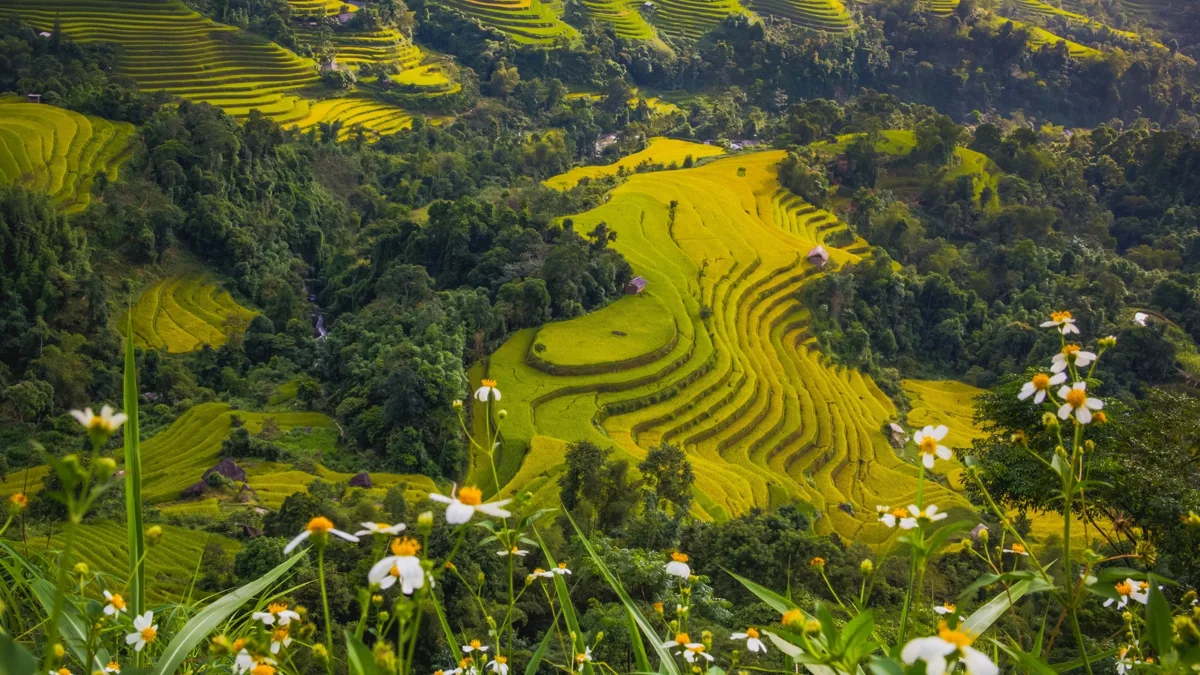
In Vietnam's northwest, the mountainous town of Sapa in Lao Cai Province is renowned for its extensive terraced rice fields. These human-made landscapes, some dating back to the 15th century and even older, are etched into the steep slopes by indigenous minority groups over generations. The intricate patterns of these terraces blend with the natural contours of the hills, creating a captivating visual effect.
Sapa serves as a popular destination for trekking, allowing travelers to explore these fields and engage with local cultures. The area is inhabited by several tribal groups, such as the Black Hmong, Red Dao, Pho Lu, and Giay, whose livelihoods are deeply connected to rice farming. The Muong Hoa Valley, situated between Sapa town and Mount Fansipan, contains some of the most recognized terraced fields. While the scenery is widely celebrated, visitors should be aware that local hawkers, both young and old, frequently approach tourists to sell local products and traditional crafts.
Remote Northern Gems: Hoang Su Phi, Mu Cang Chai, and Y Ty
For those seeking a less frequented experience of Vietnam's golden rice fields, venturing into the northernmost reaches offers a more secluded encounter with nature and local customs. Regions like Hoang Su Phi in Ha Giang Province, Mu Cang Chai in Yen Bai Province, and Y Ty in Lao Cai Province are known for their striking terraced landscapes, which have attracted attention despite their remote locations.
These areas, historically among the country's poorer regions, showcase terraced fields meticulously crafted by the ancestors of local hill tribes centuries ago. The crop season here also typically spans from September to October, during which the entire landscape is covered in expansive golden paddies. The rugged terrain and well-preserved indigenous cultures provide an authentic impression of rural Vietnam, making the journey to these locations particularly rewarding for photographers and those interested in deep cultural immersion.
Practical Advice for Visiting Golden Rice Fields
Planning a trip to see Vietnam's golden rice fields requires consideration of timing and logistics. The harvest season is relatively brief, so confirming the specific dates for the region you intend to visit is important, as these can fluctuate annually.
- Best Time: Generally, the second half of September through the first half of October.
- Transportation: Many northern destinations are accessible from Hanoi. Options include buses, private cars, or for longer distances, an overnight train journey can be considered for reaching areas like Lao Cai (for Sapa).
- Accommodation: Book accommodations in advance, especially during peak harvest season, as popular areas can fill up.
- Activities: Consider guided treks, cycling tours, or boat trips depending on the location to fully appreciate the scenery and local life.
- Cultural Sensitivity: When visiting ethnic minority villages, always show respect for local customs and traditions. Ask permission before taking photographs of people.
- Weather: While generally pleasant, be prepared for varying weather conditions in mountainous regions, including potential rain.
- Local Interactions: In some tourist-heavy areas like Sapa, be prepared for approaches from vendors. A polite "no, thank you" is usually sufficient.
Comparison of Golden Rice Field Destinations
s>| Feature | Tam Coc (Ninh Binh) | Bac Son Valley (Lang Son) | Sapa (Lao Cai) | Hoang Su Phi, Mu Cang Chai, Y Ty (Ha Giang, Yen Bai, Lao Cai) |
|---|---|---|---|---|
| Distance from Hanoi | ~100 km (South) | ~250 km (Northeast) | ~315 km (Northwest, via Lao Cai) | ~300-400+ km (Far North) |
| Primary View | Submerged fields, limestone karsts, riverine | Valley floor, surrounding mountains, winding rivers | Mountainous terraces, deep valleys | Extensive terraced fields, rugged terrain |
| Main Activities | Boat trips, cycling, rural observation | Hiking for panoramic views | Trekking, cultural village visits, photography | Trekking, cultural immersion, photography, remote exploration |
| Cultural Aspect | Rural way of living | 6 ethnic groups (Tay, Kinh, Dao, Nung, H'Mong) | Black Hmong, Red Dao, Pho Lu, Giay (hill tribes) | Well-preserved tribal cultures, less tourist-influenced |
| Accessibility | Easy day trip from Hanoi | Longer day trip or overnight from Hanoi | Overnight travel from Hanoi (train/bus) | Multi-day trip, more challenging access |
| Crowd Level | Can be busy, popular tourist spot | Less crowded | Very popular, can be crowded, hawkers present | Remote, significantly less crowded |
Frequently Asked Questions
When is the best time to see golden rice fields in Vietnam?
The optimal period to observe Vietnam's golden rice fields is typically from the latter half of September through the first half of October. This is when the rice ripens and turns a golden hue before harvest.
Which regions in Vietnam are famous for their golden rice fields?
Key regions known for their golden rice fields include Tam Coc (Ninh Binh), Bac Son Valley (Lang Son), Sapa (Lao Cai), and the more remote areas of Hoang Su Phi (Ha Giang), Mu Cang Chai (Yen Bai), and Y Ty (Lao Cai).
What activities can I do when visiting these rice fields?
Activities vary by location but often include boat trips through submerged fields (Tam Coc), hiking to panoramic viewpoints (Bac Son, Sapa), trekking through terraced fields to visit ethnic villages (Sapa, Hoang Su Phi), and cycling through rural landscapes.
Is it possible to visit these locations on a day trip from Hanoi?
Tam Coc in Ninh Binh is easily accessible for a day trip from Hanoi due to its proximity. Bac Son Valley is further, making it a longer day trip or an overnight stay. Sapa and the other northern destinations generally require multiple days due to travel time.
Are there any cultural considerations when visiting ethnic minority areas?
Yes, it is important to be respectful of local customs and traditions. Always ask for permission before photographing individuals, and be mindful of local etiquette, especially when entering homes or sacred spaces. Supporting local communities through ethical tourism is encouraged.