
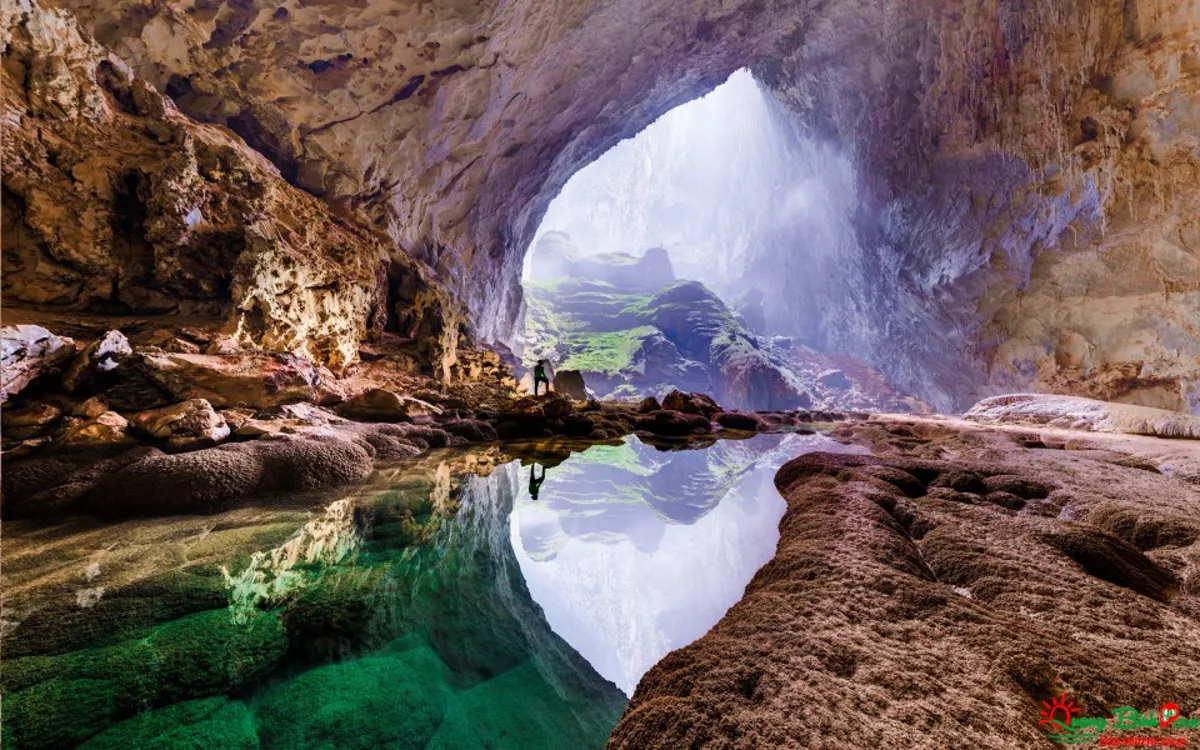
Son Doong Cave, located within the UNESCO-designated Phong Nha-Ke Bang National Park in Quang Binh province, Vietnam, holds the distinction of being the world's largest cave by cross-sectional area. This immense natural formation offers a challenging yet rewarding experience for those seeking an extraordinary adventure into a subterranean world. Its vast chambers and unique ecosystem present a compelling destination for experienced trekkers and cave enthusiasts.
The cave, estimated to be between two and five million years old, is part of an ancient karst region dating back 400 million years. Its formation is attributed to the erosion of limestone by the Rao Thuong River along a fault line in the Truong Son mountain range. Over millennia, this process carved a massive tunnel beneath the mountains, with sections of the ceiling eventually collapsing to create dramatic openings to the surface, known as dolines. These openings allow sunlight to penetrate, fostering unique underground forests.
The Discovery and Naming of Son Doong
The initial discovery of Son Doong Cave is credited to Ho Khanh, a local resident, in 1990. While foraging for food and timber in the Phong Nha-Ke Bang National Park, he sought refuge from a storm and encountered a deep opening at the base of a cliff, from which wind and mist emerged. The unusual sounds and appearance deterred him from entering at the time, and the cave's precise location was subsequently forgotten.
Years later, in 2008, Ho Khanh rediscovered the entrance during another foraging trip. The following year, he guided British Caving Research Association (BCRA) members Howard and Deb Limbert to the site. Their initial exploration in 2009 was halted by a substantial flowstone barrier, later named the 'Great Wall of Vietnam'. The team successfully traversed this barrier in 2010, confirming the cave's immense scale and establishing it as the largest ever found by cross-section, a revelation that significantly impacted the global caving community. Although initially referred to as Ho Khanh Cave, the expedition team, with Mr. Khanh's consent, renamed it Son Doong, combining 'Son' (mountain) with 'Doong' from the nearby ethnic Bru-Van Kieu village.
Planning Your Son Doong Expedition
Access to Son Doong Cave is highly regulated to preserve its delicate environment, with a limit of 1,000 permits issued annually. Expeditions are exclusively organized and led by Oxalis Adventure Tours, with Howard and Deb Limbert serving as technical directors. These tours typically run from January through August each year, as heavy rains make the cave impassable during the monsoon season.
The standard expedition spans four days and three nights, accommodating a maximum of ten guests per group. Each tour is supported by a substantial team of approximately 30 staff members, including a cave expert, a dedicated tour guide, safety assistants, a chef, and porters responsible for transporting about 600kg of equipment. A strict 'leave no trace' policy is enforced, meaning all items brought into the cave, including human waste, must be removed. The expedition is rated as 'difficult' and requires participants to be physically active with prior trekking experience.
Expedition Details
| Detail | Description |
|---|---|
| Operator | Oxalis Adventure Tours (exclusive) |
| Season | January to August (yearly) |
| Duration | 4 days, 3 nights |
| Group Size | Maximum 10 guests |
| Staff Support | Approx. 30 (expert, guide, safety, chef, porters) |
| Cost (Current) | US$ 3000 per person (subject to change, verify with operator) |
| Cost Inclusions | Entrance fees (US$ 660 for park), staff fees, airport transfers, hotel, meals, administration, VAT |
| Physical Rating | Difficult (highest level) |
| Trekking Distance | 17 km jungle trekking |
| Caving Distance | 8 km inside the cave (includes rope climbs, scrambling) |
| Elevation Change | 800 meters |
| Key Climb | 90-meter 'Great Wall of Vietnam' |
| Required Gear (Guest) | Drinking water, snacks, camera, personal items |
| Provided Gear | Campsite equipment, safety gear, food |
The journey to Son Doong Cave involves two days of challenging jungle trekking and river crossings to reach the entrance. Once inside, participants engage in activities such as abseiling, climbing, crawling, and wading or swimming through subterranean rivers. Camping within the cave's vast chambers and enjoying meals prepared by the expedition chef are integral parts of the experience. The tour also includes a visit to Hang En (En Cave), recognized as the world's third-largest cave, where swimming is an option.
Inside the World's Largest Cave
Son Doong Cave hosts a remarkably distinct ecosystem, so expansive that it generates its own localized weather patterns. Within its confines, visitors can observe rare limestone cave pearls, some as large as baseballs, scattered across dried pools. The cave's geological formations are truly impressive, featuring towering stalagmites and unique phytokarst structures.
Notable features include the 'Dog's Foot Block,' a colossal natural stalactite offering panoramic views of the cave's interior. The 'Fossil Corridor' reveals cave walls adorned with coral fossils dating back 300 million years, situated near the first campsite. The first doline, often referred to as 'Watch out for dinosaurs,' is an area where a section of the cave ceiling collapsed millennia ago. This opening allows sunlight to penetrate, supporting the growth of foliage and microscopic life. Here, a large layered stalactite formation known as 'Wedding Cake' is a popular sight, alongside the 'Rat Run' cave, which provides another vantage point for viewing the doline.
Further into the cave lies the second doline, also known as the 'Garden of Edam.' This sinkhole allows ample light, fostering a small forest of trees and vegetation within the cave. The second campsite, often described as 'seaside camping,' is positioned on a sandy area resembling a beach, offering what many consider one of the world's most impressive camping views. The expedition culminates at the 'Great Wall of Vietnam,' a formidable 90-meter-tall calcite barrier, marking one of the cave's highest ceiling points at approximately 200 meters.
Beyond its geological wonders, Son Doong supports diverse life forms. Explorers have documented monkeys, snakes, squirrels, rats, flying foxes, birds, and bats. Additionally, seven previously unknown species, including fish, spiders, scorpions, shrimp, woodlice, and plankton, have been discovered. These creatures are notably white and eyeless, an evolutionary adaptation to their existence in perpetual darkness.
Practical Information for Visitors
The Son Doong Cave expedition is a demanding physical challenge. Participants should prepare for significant trekking, caving, and elevation changes. Weather conditions in the jungle can vary considerably; temperatures range from 8-15°C in January-March, requiring warm clothing, to 32-40°C in June-August. Rain can make jungle trails particularly slippery and muddy. Inside the cave, temperatures are more stable, typically between 18-23°C in winter and 22-25°C in summer, where lighter attire is sufficient at camp. It is advisable to check weather forecasts for Quang Binh province before your trip.
While swimming is not a mandatory component of the Son Doong tour, opportunities exist for swimming in Hang En and splashing in rivers during designated washing times. Guests are responsible for bringing personal items like drinking water, snacks, and a camera. All other essential items, including safety equipment, food, and camping gear, are managed by the porter team. The expedition caters to various dietary needs, including vegan and gluten-free options, provided advance notice is given.
In recent years, proposals for a cable car system to Son Doong Cave, capable of transporting 1,000 visitors per hour, have met with significant opposition from UNESCO and conservation groups like Save Son Doong. The Vietnamese government temporarily halted construction permits in 2015, and any future development would require approval from the World Heritage Committee. This ongoing debate highlights the importance of balancing tourism development with environmental preservation for such unique natural sites.
Getting to Son Doong Cave
Son Doong Cave is located within Phong Nha-Ke Bang National Park in Quang Binh Province. The nearest major access point is Dong Hoi City, approximately an hour's drive away. Travelers can reach Dong Hoi from major Vietnamese cities such as Hanoi (about 500 km to the north) and Ho Chi Minh City (about 1200 km to the south) via various transportation methods, including airplanes, trains, and coaches. For those considering overnight rail journeys in Vietnam, train services offer a scenic route to the region.
The development of cave tourism in Central Vietnam, particularly around Phong Nha-Ke Bang, has significantly transformed the region. Once among Vietnam's less affluent areas, it has evolved into a globally recognized hub for cave exploration and one of the country's fastest-growing tourist destinations. For adventurers meeting the physical requirements, a Son Doong expedition represents a singular opportunity to experience one of the planet's most remarkable natural wonders.
Frequently Asked Questions
How large is Son Doong Cave?
Son Doong Cave is recognized as the world's largest cave by cross-section. It measures over 200 meters high, 175 meters wide, and extends for 9.4 kilometers. Its total volume is approximately 38.5 million cubic meters, with an additional 1.6 million cubic meters identified in a 2019 discovery.
Who discovered Son Doong Cave?
The cave was first discovered by local resident Ho Khanh in 1990. He rediscovered its entrance in 2008 and subsequently led British caving experts Howard and Deb Limbert to the site in 2009, leading to its extensive exploration and global recognition.
What is the cost of a Son Doong Cave expedition?
As of the latest information, an expedition to Son Doong Cave costs US$3000 per person. This fee covers the US$660 entrance and environmental service fees paid to Phong Nha-Ke Bang National Park, along with expenses for staff, airport transfers, accommodation, meals, and administrative costs.
What is the best time to visit Son Doong Cave?
Expeditions to Son Doong Cave are scheduled annually from January to August. The cave becomes inaccessible during the rainy season, which typically begins after August. Visiting during the dry season ensures safer and more favorable conditions for trekking and caving.
What unique features can be found inside Son Doong Cave?
Inside Son Doong Cave, visitors can observe two massive dolines (collapsed cave ceilings) that allow sunlight to create underground forests. Other notable features include the 90-meter-high 'Great Wall of Vietnam,' towering stalagmites, unique phytokarst formations, and rare cave pearls. The cave also hosts a distinct ecosystem with several species found nowhere else.








