
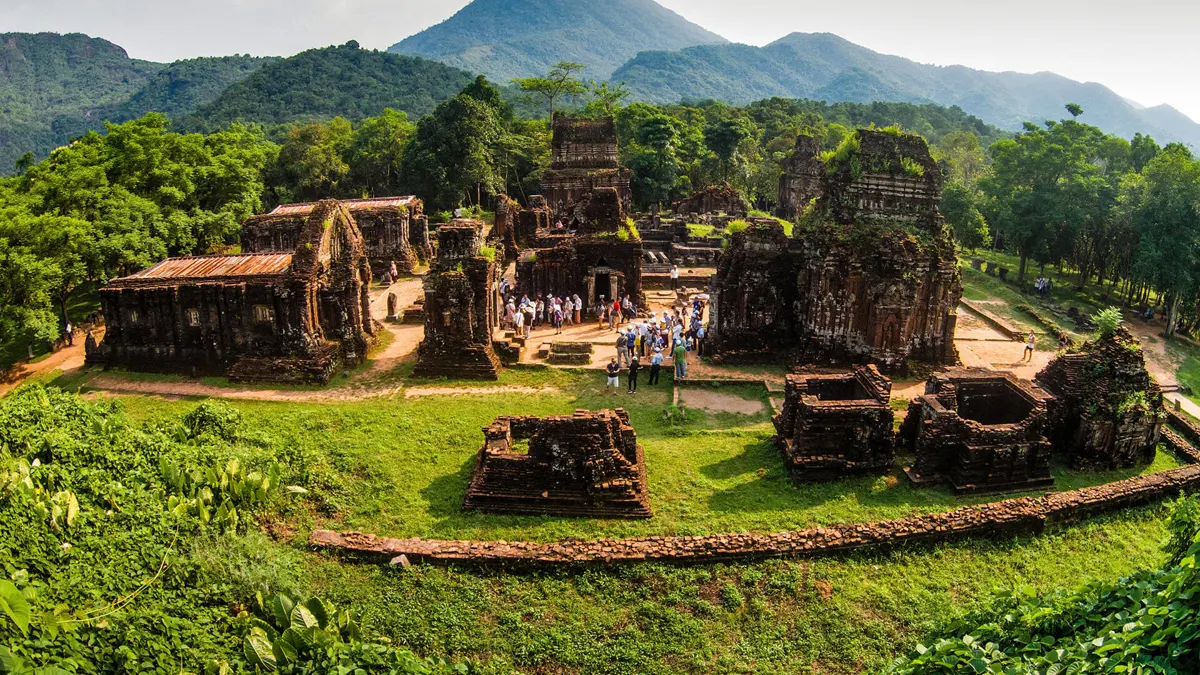
My Son Sanctuary, a UNESCO World Heritage site, represents a significant cultural and historical landmark in Central Vietnam. Situated within Quang Nam Province, this ancient complex served as the primary religious and political center for the Champa Kingdom for many centuries. Visitors often include My Son in their itineraries when exploring the regions around Da Nang and Hoi An, seeking to understand the heritage of the Cham people.
The Historical Context of My Son Sanctuary
Between the 4th and 13th centuries, a distinct culture flourished along the Vietnamese coast, drawing its spiritual foundations from Indian Hinduism. The remnants of this civilization are evident in the impressive collection of tower-temples at My Son Sanctuary, which functioned as the spiritual and administrative heart of the Cham Pa Kingdom for a considerable period. Inscriptions on stone tablets and records of royal lineages confirm My Son's status as the most important sacred location for the Cham people during these centuries, illustrating their artistic and historical evolution.
The Cham people, an ethnic group in Southeast Asia, were central to the Muslim communities in both Cambodia and Vietnam. They are descendants of the Cham Pa Kingdom, which existed from the 7th to the 15th centuries, and share close ties with the Malay ethnic group. The sanctuary is positioned in the mountainous border area of Duy Xuyen District, Quang Nam Province, approximately 75 kilometers from Hoi An, 69 kilometers southwest of Da Nang, and 150 kilometers from Hue. Its location, encircled by mountains that feed the Thu Bon river, also provided strategic defensive advantages.
Initially, My Son comprised over 70 structures, predominantly temples and towers, erected by Cham monarchs to commemorate significant events during their reigns. Following the decline of the Champa Kingdom, these temples were left to the natural environment until 1903, when French archaeologist Henri Parmentier and his team initiated excavations. During this process, Parmentier categorized the My Son complex into 14 sections, labeled alphabetically. For easier navigation, each temple within a group received a specific number, such as A1, A2, B1, B2, and so forth. Currently, sections A through G are the most accessible areas, facilitated by established walking paths.
Architectural Characteristics of Cham Temples
The architectural style at My Son Sanctuary is a testament to the Cham people's ingenuity and their cultural exchanges. Historical records indicate that the original structure at My Son was a wooden temple dedicated to the deity Siva Bhadreshwara, which was later destroyed by a major fire in the late 16th century. Subsequent constructions by the Champa Kingdom's rulers utilized red bricks as the primary building material.
The sanctuary once featured more than 70 interconnected structures, including temples and towers, characterized by intricate red brickwork. The central element of Cham architectural design is the tower, conceived to symbolize the monarch's divine connection. Bricks were the fundamental component in the construction of these Cham towers. Each historical era contributed its own distinct identity, resulting in varied architectural expressions for temples dedicated to different deities or kings from various dynasties. Most temples face east, reflecting the Cham belief that the east was the dwelling place of the gods.
Each Cham tower typically consists of three distinct parts: a robust base, representing the human realm; a mysterious and sacred body, symbolizing the world of spirits; and a pinnacle, often shaped as a figure offering flowers and fruits, or depicting trees, birds, and animals, signifying elements close to both spirits and humans. My Son Sanctuary vividly demonstrates Cham-style architecture, which bears a strong influence from Indian traditions. The artistic convergence seen in the Cham towers at My Son incorporates various styles, including the ancient forms of the 7th-8th centuries, the Hoa Lai style of the 8th-9th centuries, the Dong Duong style from the mid-9th century, and the My Son and My Son-Binh Dinh styles. A notable enigma remains regarding the substance and method Cham builders employed to bond the red baked bricks into such enduring structures. Despite the destruction of many towers over time and through conflicts, the surviving sculptural and architectural fragments still convey the artistic heritage and historical narrative of the Cham people. These masterpieces signify a glorious period for Cham architecture and culture, as well as for Southeast Asia as a whole, affirming the rich traditions of a nationality within the Vietnamese community.
Planning Your Visit to My Son Sanctuary
My Son Sanctuary is located in Quang Nam Province, approximately 69 kilometers southwest of Da Nang City and 75 kilometers from Hoi An. The site is open to visitors daily from 6 AM to 5 PM. The current entrance fee is 150,000 VND for international visitors and 100,000 VND for local visitors. Please note that opening hours and entrance fees are subject to change and should be verified closer to your travel date.
For an optimal experience, consider visiting My Son early in the morning, immediately after the gates open, to avoid the intense heat that often characterizes the area. However, it is worth noting that sunrise tours are increasingly popular. Another suitable option is to arrive in the afternoon, around 2 PM, when the morning crowds have typically departed. Upon passing the ticket checkpoint, visitors will find a small museum offering insights into the discovery and preservation of My Son, along with a display of artifacts. Given the often hot weather, utilizing the complimentary electric shuttle service for the 10-minute ride to the ruins is advisable to conserve energy. Shuttles depart every 15-25 minutes, transporting guests through lush landscapes before dropping them a short walk from the main temple areas.
Transportation Options to My Son Sanctuary
Travelers have several choices for reaching My Son Sanctuary from Da Nang or Hoi An, each offering different levels of convenience and cost.
| Transportation Method | Description | Estimated One-Way Cost (Current as of 2020) | Pros | Cons |
|---|---|---|---|---|
| Taxi | Direct private transfer from Da Nang or Hoi An. | 700,000 VND to 800,000 VND | Fastest, most direct. | Most expensive. |
| Local Bus | Bus number 06 from Da Nang Central Bus Station directly to My Son. | 8,000 VND to 30,000 VND | Most economical. | Long waiting times, less direct from Hoi An. |
| Motorbike | Self-drive option, typically rented in Da Nang or Hoi An. | Varies by rental, fuel cost. | Flexibility, suitable for exploration. | Roads can be busy and dusty for much of the journey; rural views only in the last 10 km. |
| Private Car/Van | Pre-booked service with a driver, often including a guide. | Varies by provider and package. | Comfortable, convenient, stops for photos, often includes a guide. | Higher cost than bus or motorbike. |
Please note that transportation costs are subject to change and should be confirmed with providers prior to travel.
For those traveling from Da Nang, understanding financial services in Da Nang can be helpful. Similarly, visitors originating from Hoi An might find it useful to know about banking services in Hoi An.
Practical Advice for Exploring My Son
The climate at My Son is frequently warm, making the free electric shuttle a practical choice for navigating the site. This service transports visitors through natural surroundings to the vicinity of the ruins, minimizing walking distance in the heat.
For safety reasons, it is crucial to remain on designated paths and avoid venturing into the dense forest independently. This precaution is necessary because de-mining operations are still ongoing in certain areas around My Son Sanctuary.
Visitors can also experience a traditional Cham dance performance, which takes place in a dedicated performance hall three times daily. Show timings are at 09:30, 10:30, and 2:30. These performances feature local dancers moving to rhythmic music, offering a glimpse into Cham cultural traditions.
Frequently Asked Questions
What is My Son Sanctuary?
My Son Sanctuary is a UNESCO World Heritage site in Central Vietnam, comprising a collection of ancient Hindu temples built by the Cham people between the 4th and 13th centuries. It served as the religious and political capital of the Champa Kingdom.
How far is My Son Sanctuary from Da Nang and Hoi An?
My Son Sanctuary is approximately 69 kilometers southwest of Da Nang City and about 75 kilometers from Hoi An. Travel times vary depending on the chosen mode of transportation.
What are the operating hours and entrance fees for My Son Sanctuary?
The sanctuary is typically open from 6 AM to 5 PM daily. The entrance fee for international visitors is 150,000 VND, while local visitors pay 100,000 VND. It is advisable to check current hours and fees before your visit.
Is there a dress code for visiting My Son Sanctuary?
While there is no strict dress code, as My Son is a religious site, it is respectful to dress modestly. Comfortable clothing and footwear are recommended due to walking and the warm climate.
What facilities are available at My Son Sanctuary?
Upon entry, there is a small museum. An electric shuttle service transports visitors from the entrance to the main ruins area. Restrooms are available. Traditional Cham dance shows are also offered at specific times during the day.








