
Traveling by train in Vietnam offers a distinct perspective on the country's diverse landscapes and local life. While air travel provides speed, rail journeys allow for a more gradual appreciation of the scenery and cultural interactions. This comprehensive guide provides practical advice for planning your train trip, covering everything from the railway system and ticket procurement to various seating and sleeping accommodations.
Understanding Vietnam's National Rail Network
Vietnam's railway infrastructure connects provinces throughout the country, stretching approximately 1,600 kilometers. This network allows travelers to traverse various regions, including the northern areas around Lao Cai (a gateway to Sapa) and Hanoi, the central cities of Hue and Da Nang, and Ho Chi Minh City in the south. The main line, often referred to as the 'Reunification Express,' runs the length of the country, offering a continuous path for exploration.
When reviewing train schedules or booking tickets, you will typically encounter train designations beginning with 'SE' or 'SP' followed by a number. 'SE' trains are Super Express services that operate along the north-south corridor, connecting major cities like Hanoi and Ho Chi Minh City. 'SP' trains are specifically assigned to the route between Hanoi and Lao Cai, serving travelers heading towards the mountainous regions. Beyond the primary north-south line, other significant routes include Hanoi – Hai Phong, Hanoi – Quan Trieu, Hanoi – Dong Dang, and Kep – Uong Bi – Ha Long. An international rail service also connects Hanoi to Beijing, China, passing through Dong Dang Station in Lang Son province.
Advantages of Choosing Rail Travel in Vietnam
In recent years, train travel has become an increasingly popular option for exploring Vietnam, praised for its convenience and cost-effectiveness. A train journey provides an opportunity to observe the country's natural beauty and daily life at a relaxed pace, allowing passengers to capture memorable moments as they move through different regions.
One of the primary draws of rail travel is the opportunity to witness Vietnam's varied scenery up close. The routes often pass through mountains, expansive rice fields, and coastal areas, presenting a continuous visual narrative. Beyond the views, trains offer a chance for cultural engagement. Passengers often find themselves interacting with local residents and can sample regional foods or purchase small items at various railway stops, fostering a deeper connection with Vietnamese culture. Additionally, train travel is generally more economical than flying and can sometimes be less expensive than bus services, making it an attractive choice for budget-conscious travelers. For those carrying substantial luggage, trains typically permit up to 20 kg per passenger, a more generous allowance compared to the 7 kg often permitted in economy class or 14 kg in business class on flights.
Acquiring Train Tickets in Vietnam
Securing train tickets in Vietnam can be done through a couple of primary methods: purchasing directly at a train station or booking online. While buying tickets at the station is an option, it can sometimes involve longer waiting times and potential language barriers. For these reasons, online booking is frequently recommended as a more straightforward and efficient approach.
Online booking offers several advantages, including protection against ticket fraud and reselling, as you typically receive an official e-ticket. This method simplifies the process, eliminating the need to wait in queues at the station, which is particularly beneficial if you do not speak Vietnamese. Payments can be made securely online using various methods, including credit cards. Online platforms often provide support for selecting specific seats or berths, and some may offer reviews and images of the train services to help inform your choice. For reservations made with Vietnam Railways, New Livitrans Express, and Violette Train, an e-ticket is issued via email, which can be printed and presented directly upon boarding. However, for private rail operators such as Victoria Express, Fanxipan Express, King Express, Orient Express, Sapaly Express, Chapa Express, and Saigon Golden Train, as well as the international railway service connecting Hanoi to Nanning and Beijing, passengers typically receive a voucher by email. This voucher must be exchanged for a physical ticket at the station prior to departure.
Selecting Your Comfort Level: Train Seating and Sleeping Options
Vietnam's trains offer a range of seating and sleeping accommodations to suit different preferences and budgets. Understanding these options is key to planning a comfortable journey, especially for longer routes. From basic fixed seats to private luxury cabins, there is a choice for nearly every traveler.
The most economical option is the ordinary hard seat. These seats are fixed and do not recline, which can become uncomfortable on extended trips. While suitable for short distances or for travelers with robust health looking to minimize costs, they are generally not recommended for very long journeys. A step up in comfort is the soft seat, which allows for a recline of approximately 15 degrees. These seats offer a more relaxed experience and are popular for medium-length trips, providing a better view of the passing scenery. However, even soft seats can lead to fatigue on particularly long routes.
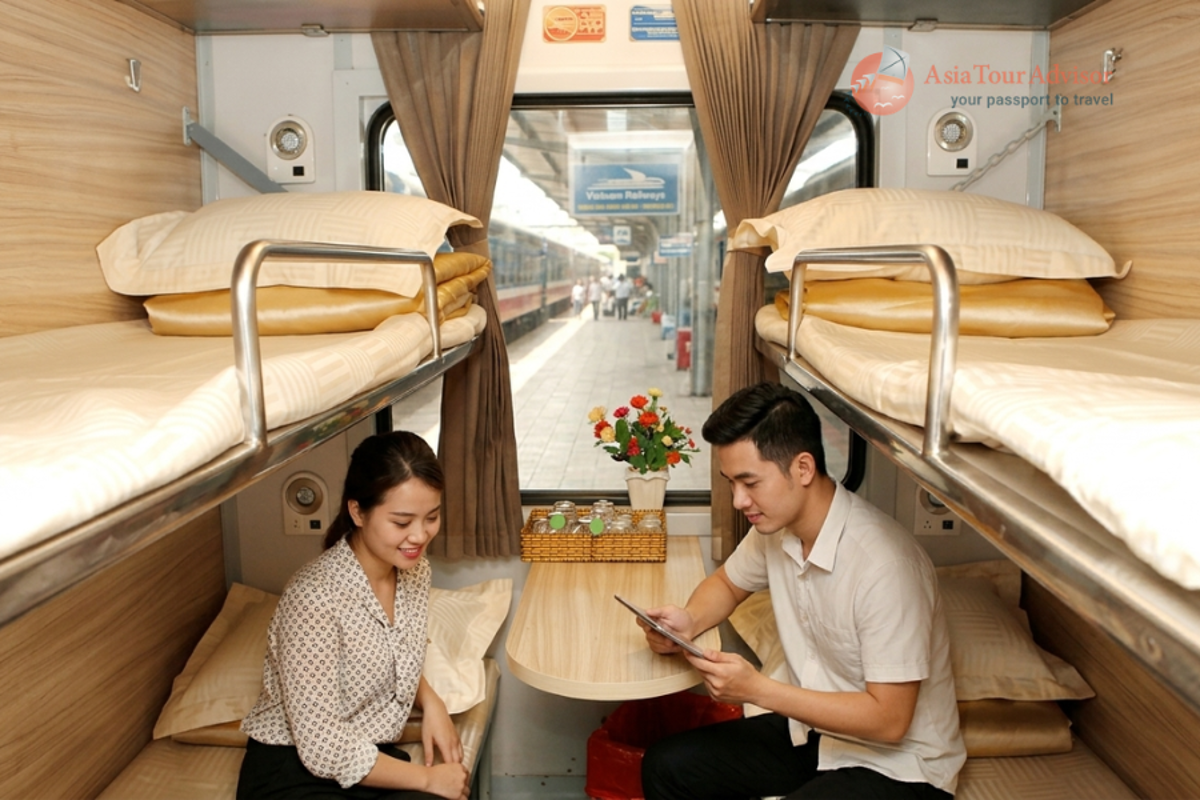
For journeys lasting many hours or overnight, the soft sleeper (soft berth) is a preferred choice. These accommodations provide a bed, allowing passengers to rest or sleep comfortably. While more expensive than seats, the added comfort is often considered worthwhile for extended travel. The most premium option available is the luxury train cabin, typically featuring two berths. These spacious, air-conditioned cabins include soft mattresses, complimentary tea, and fruits. They offer a high level of comfort and privacy, making them ideal for individuals or small groups seeking a more exclusive experience. Reserving both berths in a luxury cabin ensures private time with companions. For those considering longer trips, particularly overnight rail journeys, understanding the various comfort options is crucial for a pleasant experience. More details on these can be found in a guide to navigating Vietnam's sleeper trains.
| Feature | Ordinary Hard Seat | Soft Seat | Soft Sleeper (Berth) | Luxury Cabin (2 Berths) |
|---|---|---|---|---|
| Comfort Level | Basic, fixed | Moderate, 15° recline | High, full bed | Premium, soft mattress |
| Privacy | Low | Low | Moderate (shared cabin) | High (private cabin) |
| Suitability | Short trips, budget | Medium trips, comfort | Long trips, overnight | Long trips, premium experience |
| Amenities | None specified | None specified | None specified | AC, complimentary tea/fruits |
| Price Point | Most economical | Average | Higher | Most expensive |
Practical Advice for Traveling by Train with Children
Traveling with children on Vietnamese trains requires some specific considerations regarding tickets and identification. Children under six years old can travel without a ticket if they share a seat or bunk with an adult. It is important to have their passport ready for identification purposes before boarding. For children aged six to nine, a 25% discount is applied to the standard ticket price for both seats and sleeping berths. Children ten years and older are subject to adult fares and must be accompanied by an adult at the time of departure.
General Tips for a Pleasant Train Journey
To ensure a smooth and enjoyable train experience in Vietnam, a few preparatory steps are advisable. Always print your electronic tickets if you have them, as this simplifies the boarding process. It is also essential to carry your passport or other valid identification, as these documents will be checked. Plan to arrive at the train station at least 60 minutes before the scheduled departure time to allow for ticket verification and boarding. Regarding luggage, passengers are typically permitted to bring up to 20 kg; ensure your belongings are secure and easily manageable. While food and beverages are often available for purchase on trains or at stations, preparing your own snacks and drinks beforehand can be a convenient option. As part of the local experience, many travelers enjoy taking photographs at locations like the 'Vietnam train street,' a unique urban railway feature. When exploring local markets or shops near railway stops, consider looking for essential souvenirs and unique purchases to bring home. For those traveling to northern regions, such as Lao Cai, which serves as a gateway to Sapa, visitors might also be interested in exploring options for experiencing Mount Fansipan.
Frequently Asked Questions
How far in advance should I purchase train tickets in Vietnam?
It is advisable to book train tickets, especially for popular routes or during peak travel seasons, several days or even weeks in advance. Online booking platforms typically allow for earlier reservations, securing your preferred class and time.
Are there dining options available on Vietnamese trains?
Most long-distance trains in Vietnam offer some form of dining service, ranging from snack carts to dedicated dining cars. Passengers can usually purchase hot meals, drinks, and light refreshments. However, bringing your own food and beverages is also permitted and can be a good alternative.
What is the difference between an e-ticket and a voucher for train travel?
An e-ticket is a digital ticket sent via email that can be printed and used directly for boarding. A voucher, on the other hand, is an electronic confirmation that needs to be exchanged for a physical ticket at the train station before you can board your train. This distinction primarily applies to tickets booked with private rail companies or for international routes.
Is Wi-Fi available on Vietnamese trains?
While some newer or luxury train services might offer Wi-Fi, it is not universally available across the entire Vietnamese railway network. Connectivity can also be intermittent, especially in remote areas. It is recommended to not rely solely on train Wi-Fi for important communication or entertainment.
What identification is required for train travel in Vietnam?
Passengers are required to carry a valid passport or a national identification card when traveling by train in Vietnam. This is necessary for ticket verification and boarding procedures, especially for children traveling under specific age-based discounts.








