A month-long trip through Thailand, Vietnam, and Cambodia offers a comprehensive opportunity to experience the distinct historical sites, cultural practices, and natural beauty of these three Southeast Asian nations. This itinerary is designed to guide travelers from the ancient temples and lively markets of Thailand, through the diverse landscapes and heritage cities of Vietnam, and concluding with the monumental wonders of Cambodia.
Planning Your Month-Long Southeast Asia Expedition
Successfully navigating a multi-country tour across Southeast Asia requires some advance consideration, particularly regarding the optimal travel period and the overall flow of your journey. This section outlines key planning aspects to ensure a smooth and enjoyable experience.
Best Time to Travel
The most favorable period for this extensive itinerary across Thailand, Vietnam, and Cambodia generally spans from November to April. During these months, most regions experience dry and pleasant weather conditions. Northern areas, such as Hanoi and the mountainous parts of northern Thailand, offer comfortable temperatures, which are ideal for sightseeing and outdoor activities like trekking. These conditions are also well-suited for boat trips in Halong Bay and exploring the ancient temple complexes of Angkor Wat. While the rainy season, from May to October, brings occasional showers, it also results in lush green scenery, fewer crowds, and distinct travel experiences.
General Route Overview
This 30-day journey typically commences in Thailand, often with an arrival in Bangkok due to frequently more economical flight options. The route then progresses to Vietnam, moving from north to south, before crossing into Cambodia for the final segment. This progression allows for a logical flow, minimizing extensive backtracking and maximizing exploration time across diverse environments, from bustling metropolises to serene rural areas and historical sites.
Exploring Thailand: A Nine-Day Itinerary
The initial nine days of this Southeast Asian adventure are dedicated to Thailand, showcasing its spiritual heritage, historical depth, and natural attractions. From the capital's grandeur to northern cultural centers, visitors will encounter a wide array of experiences.
Bangkok: Capital City Highlights
Your journey begins in Bangkok, Thailand's capital. After arriving and settling in, the second day is dedicated to exploring the city's significant cultural landmarks. Recommended sites include Wat Traimit, situated in Chinatown, known for its immense solid gold Buddha image, which stands three meters tall and weighs 5.5 tonnes. The second floor of the building features exhibits on Bangkok's Chinatown history, while the third floor details the statue's creation. Wat Pho, also known as the Temple of the Reclining Buddha, is one of the city's largest temple complexes, housing a 46-meter-long, gold-leaf-covered reclining Buddha. This location is also recognized as a prominent center for traditional Thai massage. The Grand Palace complex, the official residence of Thai kings since 1782, is considered the spiritual heart of the kingdom, with its most notable structure being the Temple of the Emerald Buddha (Wat Phra Kaew), home to a revered 14th-century Emerald Buddha. Wat Arun, or Wat Chaeng, is a striking temple on the west bank of the Chao Phraya River, particularly impressive at sunset when illuminated. Its 79-meter tower is adorned with colored glass and Chinese porcelain. After a full day of historical exploration, an evening tuk-tuk tour can reveal Bangkok's night atmosphere, with street food available at Phetchaburi Soi 5, offering dishes like coconut pudding and Thai-style grilled meats. Landmarks such as The Marble Temple and the Anantasamakom Throne Hall can also be observed.
Historical Sites and Floating Markets
Day three involves an excursion to the neighboring provinces of Ratchaburi and Kanchanaburi. Ratchaburi, approximately 80 kilometers west of Bangkok, is known for its natural and cultural attractions, including the Damnoen Saduak Floating Market. This market, one of Thailand's most popular, is best visited early in the morning to avoid heat and crowds. Here, vendors in small rowing boats sell agricultural products and local foods, and bargaining is common. Exploring by long-tail boat offers views of houses on stilts, while smaller wooden paddle boats allow closer interaction with vendors and opportunities to purchase local items and try Thai pancakes, dumplings, Pad Thai, or fresh fruits. Kanchanaburi, bordering Ratchaburi, offers insights into Thailand's World War II history. Key sites include the Bridge over the River Kwai, part of the Thai-Burma Railway, built by Allied prisoners of war and Asian laborers under harsh conditions. The Death Railway itself, a 415-kilometer line between Ban Pong, Thailand, and Thanbyuzayat, Burma, was constructed with significant loss of life. The Kanchanaburi Allied War Cemetery serves as the final resting place for nearly 7,000 casualties, including Commonwealth and Dutch graves, many of whom died during the railway's construction. After this full-day tour, travelers return to Bangkok for the night.
Ancient Capitals and Northern Landscapes
The journey northward begins on day four, traveling from Bangkok to Phitsanulok with stops at several significant locations. Bang Pa-In Royal Palace, also known as the Summer Palace, is a former royal complex featuring diverse architectural styles, including Chinese, traditional Thai, and European influences, set amidst expansive lawns and water features. Ayutthaya, the former capital of the Thai Kingdom, was once a major trading port with over 400 temples. Although largely destroyed by the Burmese in 1767, several structures have been restored and are part of the UNESCO World Heritage-listed Ayutthaya Historical Park, which includes Wat Phra Ram, Wat Phra Si Sanphet, Wat Mahathat, and Wat Ratchaburana. Further north in Lopburi, Phra Prang Sam Yod, a Khmer-era monument, is notable for its three laterite prangs and the numerous monkeys inhabiting the area. The Sarn Prakarn Temple, dedicated to the Hindu Goddess Kali, is also visited before an overnight stay in Phitsanulok, an ancient city serving as a crossroads between northern and central Thailand. Day five continues the northern progression, traveling from Phitsanulok through Sukhothai to Chiang Rai. Sukhothai, the first capital of Siam in the 13th century, is considered the birthplace of Thai art, architecture, and language. Here, visitors explore Wat Sra Sri, a temple on an island featuring a Sri Lankan-style chedi and a walking Buddha, and Wat Sri Chum, known for its large 15-meter-high Buddha image, Phra Achana. The day concludes with an overnight stay in Chiang Rai.
Chiang Rai and Chiang Mai: Cultural North
Day six focuses on Chiang Rai province, a mountainous region bordering Myanmar and Laos, known for its diverse ethnic populations. The itinerary includes visits to villages of the Akha and Yao hill tribes, followed by a drive to Mae Sai, Thailand's northernmost town on the Burmese border. The famous Golden Triangle marks the meeting point of Burma, Laos, and Thailand. An optional boat trip on the Mekong River offers a closer view of the borders. The Old Opium House, a museum in the Golden Triangle, provides insights into the historical opium trade, displaying tools and artifacts related to its cultivation and trade. The day continues to Chiang Saen, a provincial town on the Mekong River. On day seven, the journey proceeds from Chiang Rai to Chiang Mai, with stops at Mae Ka Chan hot springs and Wat Phra That Doi Suthep. Chiang Mai is recognized for its misty mountains, hill tribe cultures, and as a hub for shopping and adventure. Wat Phra That Doi Suthep, a significant temple, offers impressive views of downtown Chiang Mai. In the evening, a Traditional Khantoke Dinner and Show provides an opportunity to sample northern Thai cuisine served family-style at low tables, accompanied by cultural performances, including dances and music from various hill tribes. Day eight in Chiang Mai includes a full-day tour to an Elephant Camp, providing a chance to observe elephants in a sanctuary setting and learn about their care. The Orchid & Butterfly Farm showcases various orchid species and features a butterfly breeding enclosure, alongside a gift shop. The day concludes with visits to handicraft villages at San Kampaeng, where artisans create items such as woodcarvings, gems, silverware, and Thai silks. On day nine, travelers depart Chiang Mai for a flight to Hanoi, Vietnam, marking the transition to the next country.
Discovering Vietnam: A Sixteen-Day Journey
Vietnam's segment of the journey spans sixteen days, covering its historical capital, northern highlands, central coast, and the southern delta, offering a deep insight into the country's varied landscapes and traditions.
Hanoi and Northern Highlands
Day ten begins in Hanoi with a half-day city tour, visiting key sites such as The Temple of Literature, Vietnam's first university established in 1076, now a memorial to education. The Ho Chi Minh Mausoleum serves as the final resting place for Vietnam's iconic leader, 'Uncle Ho,' whose body is preserved there. The One Pillar Pagoda, a distinctive architectural structure, symbolizes Hanoi's long history. Tran Quoc Buddhist Pagoda, over 1,500 years old, is regarded as Hanoi's most ancient pagoda. After the city tour, an overnight train departs for Lao Cai, serving as a gateway to Sapa. A Hanoi street food tour in the afternoon is recommended before boarding the train. On day eleven, upon arrival at Lao Cai train station, a shuttle bus transports travelers to Sapa town. Sapa is renowned for its rugged scenery and cultural diversity, situated in the Hoang Lien Son mountain range. Trekking is a primary activity here, with routes often starting at 9:00 AM to villages like Lao Chai and Ta Van, home to Hmong and Dzay communities. Lao Chai, six kilometers from Sapa, offers views of terraced fields and streams, while Ta Van, ten kilometers away, is a peaceful village in the Muong Hoa valley. After trekking, lunch with local families provides insights into their daily lives. Mount Fansipan, Vietnam's highest peak, is also located in this region. Day twelve involves visiting Cat Cat Village, a well-known ethnic village southwest of Sapa, featuring waterfalls and remnants of a French-built hydroelectric power station. A picnic lunch by the river precedes a trek to Sin Chai Village, located at the base of Fansipan Mountain, offering scenic views. In the afternoon, a six-hour bus journey returns travelers to Hanoi.
Central Vietnam's Heritage and Coast
Day thirteen is a day tour from Hanoi to Ninh Binh province, approximately 93 kilometers south. Ninh Binh is characterized by limestone karsts, temples, pagodas, and rice paddies. Sites include Hoa Lu, the ancient capital during the Dinh and Le dynasties, with temples dedicated to Emperor Dinh Tien Hoang and Emperor Le Dai Hanh. Tam Coc, often called 'Halong Bay on Land,' is famous for its grottoes and limestone mountains, explored via a sampan trip down the Tam Coc River. For those seeking adventure, climbing to the 15th-century Bich Dong Pagoda on Ngu Nhac Mountain, comprising three separate pagodas, offers historical and scenic rewards. After the tour, a three-hour car transfer returns to Hanoi. Day fourteen marks the journey to Halong Bay, a UNESCO World Heritage site known for its limestone islands. After a four-hour transfer, travelers board a cruise, enjoying a local seafood lunch and exploring the bay's formations, caves, and activities like kayaking or swimming. An overnight stay on board is included. Early risers on day fifteen can witness the sunrise over Halong Bay's karst formations before breakfast. The vessel then cruises back to port. Travelers either return to Hanoi or proceed to Hai Phong airport for a 1-hour 20-minute flight to Hue. Halong Bay also offers several beaches for relaxation. Day sixteen is a half-day city tour of Hue, a UNESCO World Heritage site on the Huong River. Key attractions include Thien Mu Pagoda, a Buddhist site on the Perfume River; the Imperial Citadel, the former residence of the king and his family, offering insights into Vietnam's pre-modern history; and Dong Ba Market, the largest traditional trading place in Hue, selling handicrafts, clothing, and fresh produce. Day seventeen involves a road transfer from Hue to Hoi An via the Hai Van Pass, a 20-kilometer route 500 meters above sea level, providing views of mountains, Da Nang City, and the South China Sea. Day eighteen is a half-day city tour of Hoi An, an old port town known for its mixed architectural styles (Vietnamese, Japanese, Chinese, European). Notable sites include the Japanese Covered Bridge and the Phuc Kien Assembly Hall. Hoi An is also celebrated for its cuisine, with specialties like Cao Lau and Mi Quang, and its tailoring industry, with numerous shops offering custom-made clothing. Walking is the best way to explore the old streets and historical monuments. Overnight rail journeys in Vietnam are a common way to travel between cities.
Southern Vietnam and the Mekong Delta
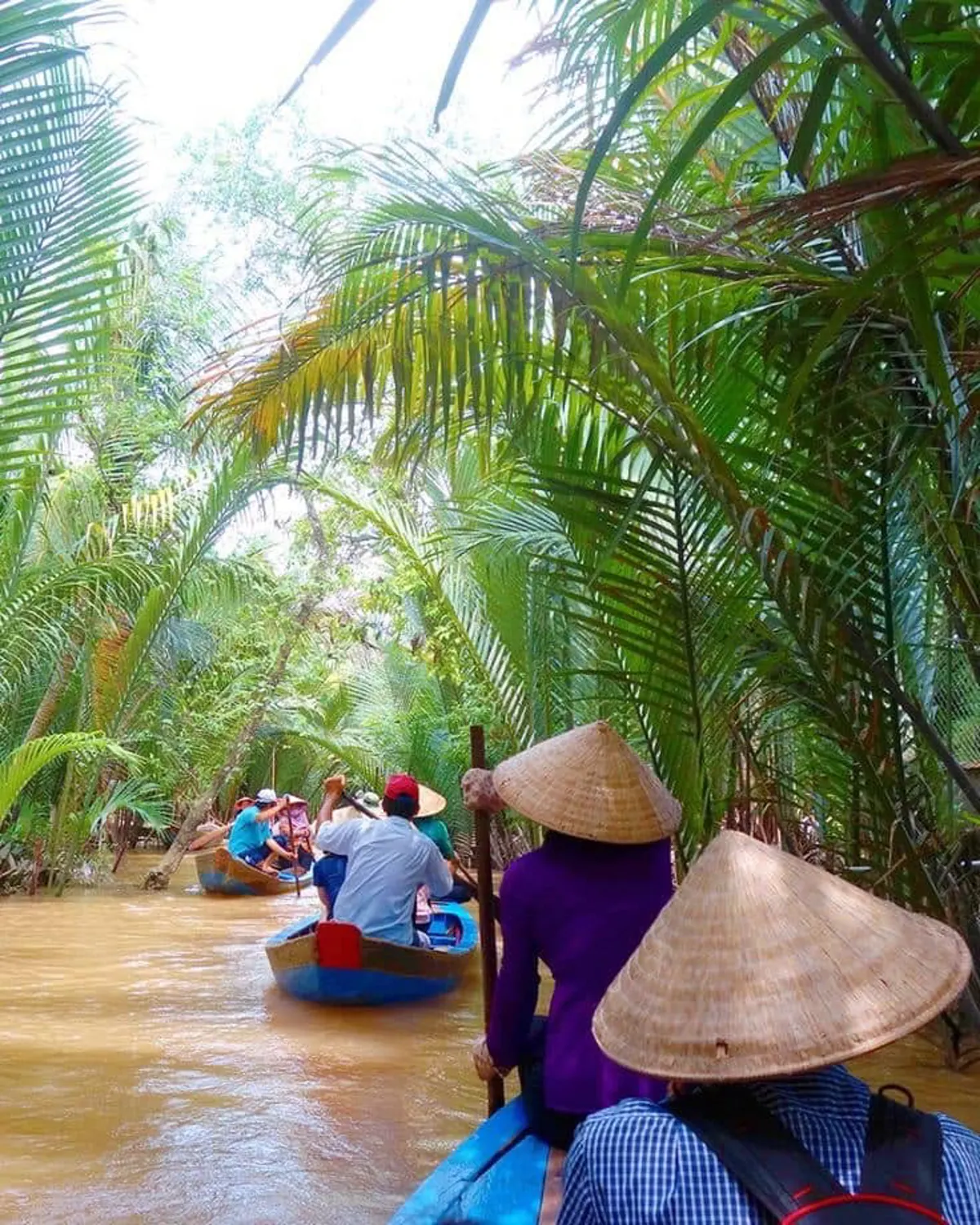
On day nineteen, travelers depart Hoi An for Da Nang to take an 8.5-hour train journey to Nha Trang. Nha Trang, a coastal city and capital of Khánh Hòa Province, has gained popularity for its beaches, scuba diving, and historical sites like the Po Nagar Tower. Days twenty and twenty-one are free days in Nha Trang, offering options such as visiting Tri Nguyen Aquarium on Bong Nguyen Island, snorkeling or scuba diving on Hon Mun Island, known for its marine life, or exploring Hon Tre (Bamboo) Island, the largest island in the Nha Trang complex. Day twenty-two involves an overnight train transfer from Nha Trang to Ho Chi Minh City. Day twenty-three begins with a morning arrival in Ho Chi Minh City, followed by a half-day city tour. This includes the War Remnants Museum, which displays artifacts and documents from the wars against Vietnam; the Old Post Office, an architectural symbol of the city; Saigon Notre Dame Cathedral, a prominent landmark; the Reunification Palace (Independence Palace), a historical monument central to the Vietnamese War; and Ben Thanh Market, a large market for local goods, souvenirs, and traditional handicrafts. On day twenty-four, an excursion to the Mekong Delta region, specifically Cai Be market in Can Tho Province, provides an escape from the city. The Mekong Delta, a vast region comprising twelve provinces, is crucial for Vietnam's rice and fish production, with local life centered around its rivers and canals. Visitors can enjoy the fresh air and explore fish and fruit farms. Day twenty-five involves an early morning visit to the Cai Rang Floating Market in Can Tho, one of the largest floating markets in the Mekong Delta, bustling between 5 AM and 8 AM. Boats display their goods on bamboo poles, creating a vibrant scene. Afterward, travelers proceed to Chau Doc, a town known for its rural cultures and peaceful landscapes, where locals engage in farming and fishing, often living in floating houses. This concludes the Vietnam portion of the trip, preparing for the border crossing into Cambodia.
Cambodia's Wonders: Five Days of History
The final five days of this journey are dedicated to Cambodia, beginning in its capital and culminating in the awe-inspiring temple complexes of Siem Reap.
Phnom Penh: The Capital's Legacy
Day twenty-six involves taking a speedboat from Chau Doc, Vietnam, across the border to Phnom Penh, the capital of Cambodia. Phnom Penh, situated at the confluence of the Mekong, Bassac, and Tonle Sap rivers, is a dynamic city with numerous historical sites and architectural marvels. Day twenty-seven features a half-day city tour of Phnom Penh. Key locations include the Independence Monument, an Angkorian-style tower built in 1958 to commemorate Cambodia's independence from France; the Royal Palace compound, a collection of buildings serving as the royal residence and an example of Khmer architecture with French influences; the Silver Pagoda, located within the Royal Palace complex, known for its 5,329 silver tiles and numerous Buddha statues adorned with precious materials; the National Museum of Cambodia, housing an extensive collection of Khmer cultural material from various historical periods; and Wat Phnom, the city's only hill with sacred sites, offering views of the city from its summit. After the city tour, a six-hour bus transfer takes travelers to Siem Reap, the gateway to the UNESCO World Heritage site of Angkor.
Siem Reap and the Angkor Complex
Day twenty-eight is a full-day exploration of the Angkor Wat complex. Ta Prohm, one of Angkor's famous temples, is known for its massive trees and roots growing through its walls, having been largely reclaimed by the jungle. Angkor Thom, the last capital of the Khmer Empire, features colossal human faces carved in stone, particularly at the Bayon Temple, which has 216 smiling faces of Avalokiteshvara. Other sites within Angkor Thom include the Royal Enclosure, Phimeanakas, the Elephant Terrace, and the Terrace of the Leper King. Angkor Wat itself is the most renowned temple on the plain of Angkor, covering 81 hectares and representing a pinnacle of Khmer art and architecture, appearing on Cambodia's national flag. In the evening, a Khmer Traditional Dance Show is often available at local restaurants. Day twenty-nine involves another full-day tour, visiting Banteay Srei, known as the 'Citadel of Women,' admired for its remarkable preservation, smaller scale, and intricate decorations. Banteay Samre, established in the 12th century, is another well-preserved complex. The tour also includes the Tonle Sap Chong Kneas Floating Village, located about 16 kilometers from Siem Reap, offering insights into the Tonle Sap village lifestyle, which is centered around fishing. Before returning to the hotel, a stop at the Old Market provides opportunities to find artifacts, jewelry, silks, carvings, and souvenirs. Day thirty allows for leisure time before departure from Siem Reap, concluding the month-long journey.
Culinary Experiences Across Indochina
Food is a significant aspect of travel through Southeast Asia, with each country presenting distinct flavors and culinary customs influenced by its history and local ingredients. Exploring the local cuisine offers a deeper connection to the culture.
| Country | Must-Try Dishes |
|---|---|
| Thailand | Pad Thai, Tom Yum Goong, Mango Sticky Rice |
| Vietnam | Pho, Banh Mi, Cao Lau |
| Cambodia | Amok Trey, Lok Lak |
In Thailand, popular dishes include Pad Thai, a flavorful stir-fried noodle dish, and Tom Yum Goong, a spicy and aromatic shrimp soup. For a sweet treat, Mango Sticky Rice, combining sweet mango with creamy coconut rice, is a favored dessert. Bangkok's street food culture is widely recognized, offering a range of options from grilled meats to tropical fruit snacks. Vietnamese cuisine is characterized by its freshness, balance, and use of herbs. Signature dishes include Pho, a fragrant noodle soup enjoyed nationwide, and Banh Mi, a baguette sandwich with French culinary influences. Visitors to Hoi An should consider trying Cao Lau, a unique noodle dish specific to the area. In Cambodia, the rich flavors of Amok Trey, a fragrant fish curry steamed in banana leaves, represent traditional Khmer cooking. Lok Lak, tender stir-fried beef served with a lime and pepper sauce, is another popular choice, often found in Siem Reap's lively night markets.
Essential Travel Advice for Your Trip
Careful preparation can enhance your 30-day journey across Southeast Asia, making it more comfortable and enjoyable. This section covers practical considerations for managing finances and packing efficiently.
Currency and Payment Methods
Each country in this itinerary uses its own currency: Thailand uses the Thai Baht (THB), Vietnam uses the Vietnamese Dong (VND), and Cambodia uses the Cambodian Riel (KHR), although US dollars are widely accepted there. Automated Teller Machines (ATMs) are readily available in major cities like Bangkok, Hanoi, and Phnom Penh. However, it is advisable to carry some local currency when venturing into smaller towns or rural areas where card payments may not be as common. While credit cards are generally accepted in hotels and larger restaurants, local markets and street food vendors typically prefer cash transactions.
Recommended Packing List
Given the typically hot, humid, and occasionally rainy climate of Southeast Asia, packing light and practical items is recommended. Essential items include lightweight, breathable clothing and comfortable walking shoes, which are crucial for exploring temples, cities, and rural landscapes. A rain jacket or poncho is useful for unexpected showers, and sunscreen and insect repellent will help maintain comfort throughout the trip. Additionally, bringing a universal power adapter and a small daypack for excursions, such as trekking in Sapa or cruising through Halong Bay's limestone islands, can prove beneficial.
Frequently Asked Questions
Is a month sufficient for visiting Thailand, Vietnam, and Cambodia?
Yes, a 30-day period allows travelers to experience the primary highlights and authentic local cultures of these three countries without feeling overly rushed between destinations.
Is this itinerary suitable for first-time visitors to Southeast Asia?
Absolutely. This itinerary focuses on well-known and accessible destinations, making it an excellent choice for individuals experiencing the region for the first time.
Can families and senior travelers undertake this 30-day journey?
Yes. This trip is designed with a balanced pace and convenient travel routes, making it appropriate for both families and senior travelers. Locations such as Hoi An, Chiang Mai, and Siem Reap offer relaxed environments, cultural activities, and diverse accommodation options that cater to different travel preferences.
What is a reasonable daily budget for this trip?
Daily expenses can vary based on individual travel style, but many travelers allocate between $80 and $120 per day. This budget typically covers meals, entrance fees, souvenirs, and optional activities. Street food and local eateries in cities like Bangkok and Ho Chi Minh City are quite affordable, making Southeast Asia a viable destination for various budget levels.